While choosing the furniture, you need to get a few things right before the first sheet is cut. A kitchen cabinet beside the sink needs careful moisture protection. A bookshelf needs to carry weight without sagging. A wardrobe shutter needs a suitable combination of plywood, finish, and hinges.
At Digna Ply, we look at these details together. As a plywood and hardware retailer, our approach starts with what you’re building, where it will be used, and your budget. We want you to understand what you’re paying for, where a higher specification serves a purpose, and how the materials will work together.
For us, choosing plywood for furniture also means thinking about its use over time. Planning sheet sizes and cuts, reducing avoidable waste, and selecting materials suited to the job are part of that decision.
In this article, we bring that practical approach to plywood grades, thicknesses, finishes, and buying checks, so you can map your requirements clearly with your carpenter before placing an order.
What makes plywood a good choice for furniture?
Look at the edge of a plywood sheet and you’ll see thin layers of wood bonded together. These layers, called veneers, are usually arranged with the grain running at right angles in adjacent layers. This construction gives plywood strength in both directions and helps control movement as moisture levels change.
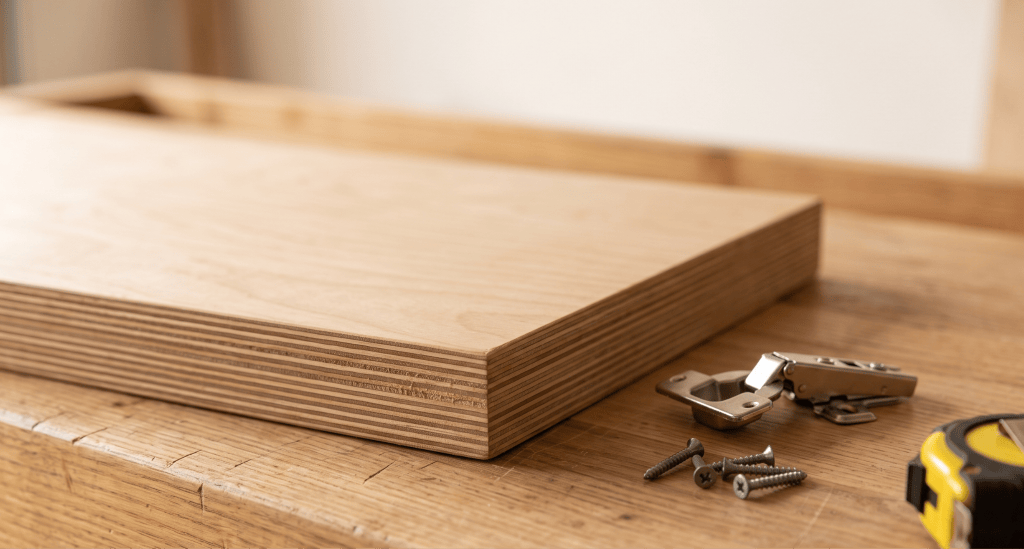
For furniture, plywood brings three practical benefits.
1. It helps panels hold their shape
Crossed layers reduce expansion and contraction along the sheet’s length and width compared with solid wood. This stability matters when cabinet panels and shutters need to stay aligned. Plywood can still warp, so suitable storage, construction, and moisture protection remain necessary.
2. It combines strength with manageable weight
Plywood’s strength relative to its weight makes it useful for furniture bodies and shelves. The sheet thickness, grain direction, load, and distance between supports still affect performance. A wide shelf carrying books needs more careful planning than a small compartment holding clothes.
3. It works well with furniture fittings
Suitable plywood provides good screw holding and can be cut and drilled with standard woodworking tools. That makes it practical for assembling cabinets and attaching hardware, provided the fixing method suits the sheet and the load.
At Digna Ply, we want these benefits to translate into a sensible material choice for your project. A smooth surface is one check; the plywood’s grade, thickness, and construction quality deserve attention too. Those details help determine whether a sheet suits the furniture you have planned.
Which type of plywood is best for furniture?
Start by asking yourself where the furniture will be used. A bedroom wardrobe and a cabinet beneath a kitchen sink face different moisture conditions, so their plywood requirements can differ.
In India, general-purpose plywood under IS 303:2024 includes MR, BWR, and BWP grades. Marine plywood follows a separate specification, IS 710:2024. Here’s how to go about choosing plywood grade for furniture:-
1. MR plywood for dry indoor furniture
MR, or moisture-resistant plywood is commonly used for wardrobes, study tables, TV units, and shelves in indoor spaces with limited moisture exposure. It can be a sensible choice when the furniture will stay dry and the selected product meets the construction requirements.
You may also hear it called commercial plywood. Ask for the actual grade and product details whenever that term appears in your quotation.
2. BWR plywood for greater moisture resistance
BWR, or boiling water resistant plywood, provides greater water resistance than MR and can suit furniture exposed to more humidity or occasional dampness. The choice should still reflect the product’s stated applications and expected conditions.
For a kitchen project, distinguish cabinets with limited moisture exposure from units beside sinks or plumbing. That gives you a clearer basis for comparing BWR and BWP options.
3. BWP plywood for moisture-prone furniture
BWP, or boiling waterproof plywood, is commonly considered for kitchen cabinets, under-sink storage, and bathroom vanity units where water exposure is more likely.
The plywood choice is one part of protecting these units. Sealed edges, suitable finishes, and prompt leak repairs also belong in the construction and maintenance plan.
4. Marine plywood when the project requires its specification
Marine plywood is manufactured to IS 710:2024, which specifies BWP-type adhesives and includes requirements for bonding, strength, water resistance, and other performance checks.
| Plywood label | Standard to check | Starting point for selection |
| MR | IS 303:2024, MR grade. | Consider it for dry indoor furniture. |
| BWR | IS 303:2024, BWR grade. | Consider it where greater moisture resistance is needed. |
| BWP | IS 303:2024, BWP grade, or the product’s stated marine certification. | Compare suitable products for moisture-prone furniture. |
| Marine | IS 710:2024. | Choose it where the project calls for marine plywood specifications. |
One thing to remember is that ‘BWP’ and ‘marine plywood’ are not interchangeable labels. BWP grade is also available under IS 303:2024, so the word “BWP” alone does not establish that a sheet meets the marine plywood standard. Check the certification stated for the particular product.
Which plywood should you choose for different furniture?
You need to make two decisions separately while choosing material for furniture.
- The grade should suit the moisture conditions.
- The thickness and supports should suit the furniture’s size and load.
This helps you spend on the specifications each part needs:-
1. Wardrobes and bedroom storage
For a wardrobe in a dry bedroom, suitable MR plywood can be a practical starting point. If the room experiences more humidity, compare BWR options against the product’s stated applications. MR plywood is commonly used for wardrobes, cabinets, and shelves with limited moisture exposure.
Then separate the wardrobe into components. The body, shelves, shutters, drawer bottoms, and back panel have different jobs. Ask your carpenter to specify their thicknesses individually, including the support needed for wide shelves and the hinges needed for large shutters.
2. Kitchen cabinets and bathroom vanities
Here, the cabinet’s position matters. Under-sink storage faces a different risk from a wall cabinet used for dry crockery. BWP plywood is commonly considered for kitchen and bathroom furniture where water exposure is more likely.
Pay particular attention to plumbing cutouts, exposed edges, and joints. Include their protection in the installation plan, and leave access for inspecting and repairing leaks.
3. Beds, tables, and bookshelves
For these pieces, look closely at what carries the weight. A bed needs a properly supported platform and sound joints. A tabletop needs support suited to its dimensions. A bookshelf needs shelves designed around the weight of the books and the distance between supports.
Plywood’s load-carrying performance depends on thickness, grain direction, and support spacing. Increasing the moisture grade alone does not resolve an unsuitable shelf design.
| Furniture item | What to settle before ordering |
| Wardrobe | Specify the body, shelf, shutter, and back-panel requirements separately. |
| Kitchen cabinet | Identify wet zones and plan protection around edges and plumbing openings. |
| Bathroom vanity | Select suitable moisture-resistant specifications and provide access to plumbing. |
| Bed | Confirm the platform support, joints, and expected load. |
| Table | Confirm the top’s dimensions, supporting frame, and intended use. |
| Bookshelf | Confirm shelf width, book load, and support placement. |
For example, two bookshelves made from the same plywood can perform differently if one has short, supported shelves and the other has wide, unsupported shelves. At Digna Ply, we encourage you to bring those dimensions with your material list so the plywood discussion starts with the furniture you are actually building.
What plywood thickness do you need for furniture?
For many wardrobes and cabinets, 18–19 mm plywood is a common starting point for the main body, while thinner sheets can serve back panels and smaller components. The thickness should be listed for each part of the furniture, because those parts carry different loads and need different support.
Use the following plywood size range when discussing your material list with your carpenter.
| Plywood thickness | Common furniture applications | What to check |
| 6–9 mm | Back panels and decorative panels. | Check how the panel will be fixed and whether it has a supporting role. |
| 12 mm | Small shelves, partitions, and selected cabinet components. | Confirm the load and distance between supports before using it for shelves. |
| 16 mm | Cabinet bodies and other components designed around this thickness. | Check compatibility with the selected hinges, fittings, and construction method. |
| 18–19 mm | Wardrobe and cabinet bodies, shelves, and suitable tabletops. | Confirm shelf spans, shutter dimensions, and the supporting frame. |
| 25 mm | Substantial tabletops, counters, and selected heavy furniture components. | Check whether the design needs the additional thickness and weight. |
These are starting points drawn from manufacturers’ furniture guidance. The final selection should follow the dimensions and construction of your piece.
Shelf width deserves particular attention. Consider a bookshelf with a shelf spanning 1,200 mm between its side panels. Adding a properly fixed central divider creates two spans of roughly 600 mm. That changes how the shelf carries its load, so support placement belongs in the thickness decision. Plywood performance also depends on the load direction and sheet properties.
You will also encounter both 18 mm and 19 mm products. Confirm the thickness available in the selected product range before finalizing the cutting list and hardware. Manufacturers sell different thickness combinations across their ranges.
At Digna Ply, we encourage you to bring a component-wise list with dimensions, quantities, and thicknesses. It makes the quotation clearer and helps you plan the sheets around the furniture you need.
Is plywood better than MDF for furniture?
The choice between MDF and plywood depends on what each furniture component needs to do. Plywood is commonly chosen for strength and screw holding, while MDF, or medium-density fiberboard, provides a smooth surface suited to painted finishes and decorative details.
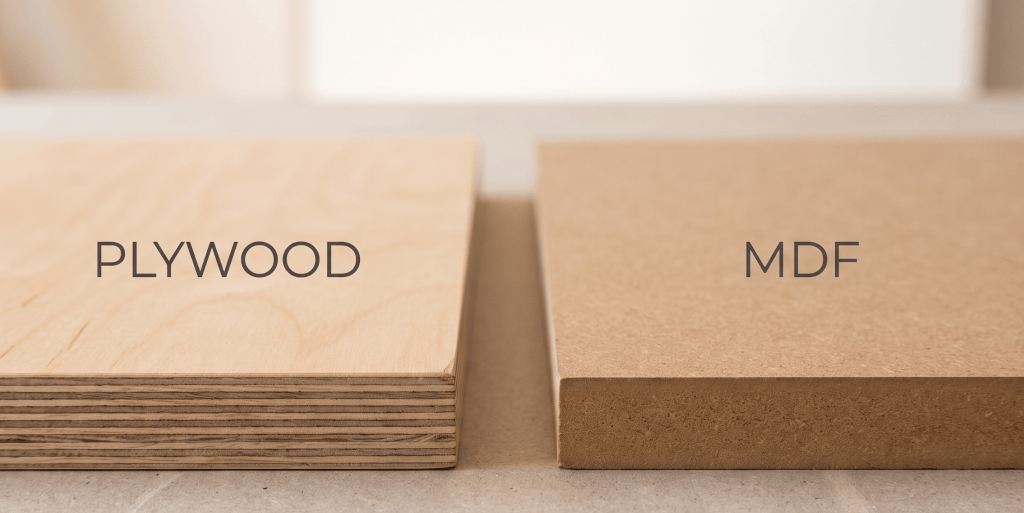
1. Strength and support
For cabinet bodies, loaded shelves, and bed components, suitable plywood is often a practical starting point. MDF can also serve furniture applications, but its specification, thickness, and supports need to match the design. We would settle these requirements before choosing either material.
2. Screw holding and hardware
Plywood generally provides good screw holding for hinges, drawer slides, and joints. MDF requires suitable fixings and careful installation, particularly near edges. With either material, the board thickness and fixing method should suit the hardware and the load it carries.
3. Moisture resistance
For plywood, choose an MR, BWR, or BWP specification suited to the conditions. Standard MDF is intended for dry interiors, while moisture-resistant MDF products have separate specifications. Check the particular product’s intended use before selecting it for kitchens or bathrooms.
4. Surface finish
Plywood works with laminates and veneers and can be prepared for painting. MDF’s uniform surface and consistent core make it useful for painted shutters, routed patterns, and decorative panels. The finish you want can therefore influence the material chosen for the visible parts.
For example, a painted wardrobe could use plywood for the body and shelves, with suitable MDF for decorative shutter fronts. We would then check shutter weight, hinge requirements, and the complete cost of boards, finishing, and hardware before finalizing the material list.
Which finish should you choose for plywood furniture?
Choose the finish alongside the plywood. It affects how your furniture looks, feels, and handles everyday cleaning. We suggest comparing options based on where the piece will be used and how much care you want to give it.
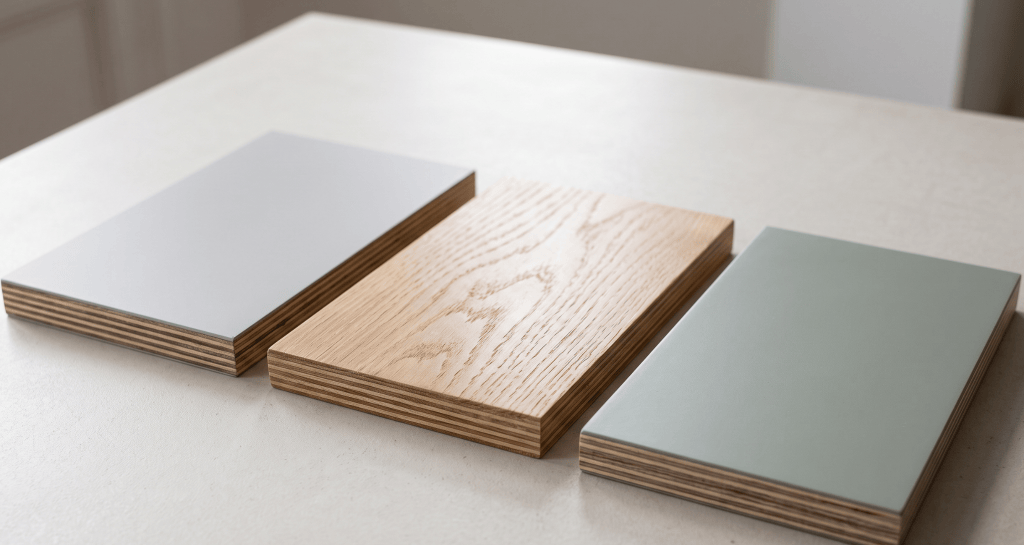
1. Laminates for everyday use
Decorative laminates are a practical option for wardrobes, cabinets, and desks. They provide a ready-made surface in different colors, patterns, and textures, with products designed to resist scratches and abrasion. Check the selected laminate’s suitability for the intended surface, especially tabletops that receive frequent use.
2. Wood veneers for natural grain
Veneers provide a real wood surface over plywood or another base material. They suit furniture where the grain is part of the design, such as wardrobe fronts, consoles, and dining tables. Ask to see a finished sample and include the required polishing or protective coating in your quotation.
3. Paint and clear finishes
Paint gives plywood furniture a solid-color finish, while a suitable clear finish keeps the face veneer visible. The result depends on surface preparation. Sanding, filling where needed, removing dust, and using compatible preparation and coating products should be included in the work plan.
Include the edges in the finishing plan. Ask your carpenter how exposed edges, corners, and cutouts will be covered or sealed. Also confirm the finish for internal surfaces and back panels before work begins.
Can plywood be used for outdoor furniture?
Plywood can work for outdoor furniture when the product, construction, and protective finish suit the exposure. A table on a covered balcony faces different conditions from one left on an open terrace through rain and direct sunlight.
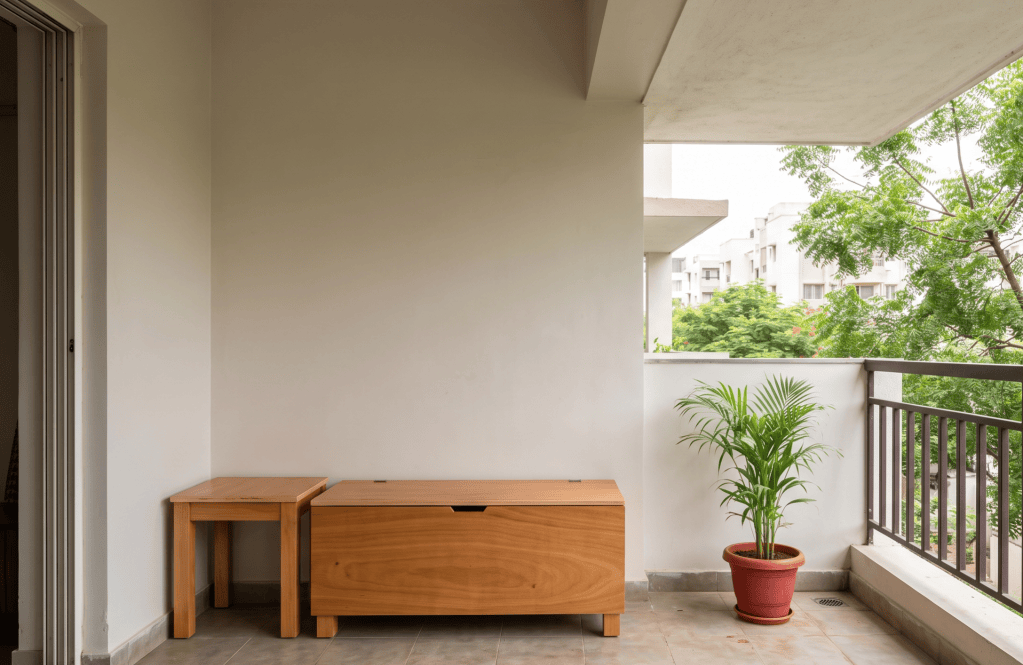
For exposed furniture, choose a product whose manufacturer confirms its suitability for that use. Suitable marine plywood can be an option, but it still needs proper sealing, edge protection, and weather-resistant coatings.
Water resistance is one part of outdoor performance. The adhesive bond’s resistance to moisture does not establish the panel’s resistance to sunlight, surface wear, or fungal decay. Those factors also depend on the material specifications, design, and protection.
Before construction, agree on three details with your carpenter.
- Specify a compatible exterior coating system and treatment for exposed edges, joints, and cutouts.
- Design the furniture so water can drain rather than collect on surfaces or around its base.
- Plan inspections and any recoating required by the finish manufacturer.
We suggest including the furniture’s location and expected weather exposure in the material list. That gives you a clearer basis for choosing the plywood and budgeting for its upkeep.
What should you check before buying plywood?
Once you have chosen the grade and thickness, check that the sheets supplied match your material list. We recommend doing this before cutting or applying laminates, while the product markings and original sheet condition are easy to inspect.
Here’s how to check the quality of plywood supplied:-
i) Read the product markings
Check the manufacturer, product name, grade, thickness, applicable standard, and BIS licence number.
For plywood marked IS 303:2024, confirm whether the grade is MR, BWR, or BWP, since the standard includes all three. For marine plywood, check the stated IS 710:2024 certification. Match these details with the product specified in your quotation.
ii) Verify the certification details
Use Verify Licence Details in the BIS Care app to check the CM/L licence number printed on the sheet. Review the manufacturer, applicable standard, licence status, and product varieties covered. Ask the seller to explain any mismatch before the sheets are used.
If the manufacturer provides a separate product-authentication system, use its official verification method too.
iii) Inspect the sheet condition
Look for visible damage, separating layers, unusually large gaps at accessible edges, and pronounced bowing. Ask your carpenter to check the dimensions and thickness against the cutting plan.
These checks help identify visible issues, but they cannot reveal every internal gap or establish the plywood’s moisture grade. Product specifications and certification remain part of the buying decision.
iv) Keep the invoice and warranty details
The invoice should identify the actual products purchased, including their thicknesses, sheet sizes, and quantities. Read the warranty terms for covered defects, exclusions, replacement arrangements, and any registration requirements.
We also suggest taking clear photographs of the sheet markings, licence number, and product labels before work begins. Keep them with the invoice and warranty records so you have a record of the materials used in your furniture.
How can you make plywood furniture last longer?
The service life of plywood furniture depends on the material, construction, finish, and conditions in which it is used. Once it is installed, we suggest focusing on a few practical habits.
1. Clean according to the surface finish
For laminates, use a soft cloth and the recommended cleaner. Avoid abrasive scrubbing, and wipe away moisture after cleaning. Painted and veneered surfaces should follow their coating manufacturer’s care instructions.
2. Remove spills and repair leaks promptly
Check cabinets around sinks and plumbing for dampness. Keeping furniture dry helps protect both the plywood and its finish.
3. Keep shelf loads within the planned design
Distribute heavy items rather than concentrating them in one place. If a shelf starts sagging, reduce the load and ask your carpenter to assess its support.
4. Protect surfaces from heat and prolonged sunlight
Use suitable mats or coasters beneath hot items, and limit sustained direct sunlight where it could affect the furniture or finish.
During cleaning, also check for loose hinges, lifting edges, or damaged coatings. Addressing small repairs early helps you keep the furniture usable and avoid replacing parts unnecessarily.
How can Digna Ply help with your furniture project?
At Digna Ply in Dehradun, we help you choose plywood and hardware around the furniture you are planning. Your material list gives us a starting point for discussing grades, thicknesses, fittings, available products, and your budget.
Bring your carpenter’s list along with any drawings, measurements, or reference photographs. Include the proposed finish and mention areas exposed to moisture, such as cabinets around sinks. These details help make the product discussion and quotation more specific.
We also encourage careful quantity planning before ordering. Matching sheet sizes to your carpenter’s cutting plan can reduce avoidable waste and help you budget for the materials the project needs.
Visit Digna Ply with your material list, or WhatsApp us at 88813 06046. Share your drawings, measurements, and material requirements to discuss suitable plywood and hardware and request a quotation for your furniture project.
Frequently asked questions
Is commercial plywood suitable for wardrobes?
MR-grade commercial plywood can suit wardrobes in dry rooms. Confirm the actual grade before buying, then choose the thickness and supports around the wardrobe’s dimensions, shelf loads, and hardware.
Is BWP plywood the same as marine plywood?
No. BWP describes a water-resistance grade, while marine plywood must meet a separate specification. IS 303:2024 includes BWP-grade plywood, and IS 710:2024 covers marine plywood. Check the standard marked on the product.
Do all kitchen cabinets need the same plywood grade?
Not necessarily. Choose the grade according to expected moisture exposure. BWP plywood is commonly considered for wet areas such as under-sink units. Protect cut edges, joints, and plumbing openings, whichever grade you choose.
Is 18 mm or 19 mm plywood suitable for bookshelves?
Both are common options, but thickness alone does not determine suitability. Shelf width, book weight, and supports also matter. A long shelf may need a central divider or additional support to limit sagging.
Does adding laminate make plywood waterproof?
No. Laminate protects the covered surface, but it does not change the plywood’s moisture-resistance grade. Water can still enter through exposed edges, joints, screw holes, and cutouts, so these areas need protection.
How can I check plywood certification before buying?
Find the BIS license number, usually marked as CM/L, on the sheet. Use Verify Licence Details in the BIS Care app, then check that the manufacturer, standard, licence status, and covered product match what you are buying.
Can plywood and MDF be used in the same furniture project?
Yes. A painted wardrobe, for example, can use plywood for its body and shelves and suitable MDF for decorative fronts. Confirm the MDF grade, shutter weight, hinge requirements, and finish with your carpenter.


Leave a Reply