In India, plywood standards are governed by the Bureau of Indian Standards. For example, IS 303 covers plywood for general purposes and classifies it into BWR and MR grades based on the bond strength developed by the adhesive used for bonding veneers. It also defines appearance-based types such as AA, AB, and BB, along with requirements for materials, manufacturing, dimensions, tolerances, tests, and marking.
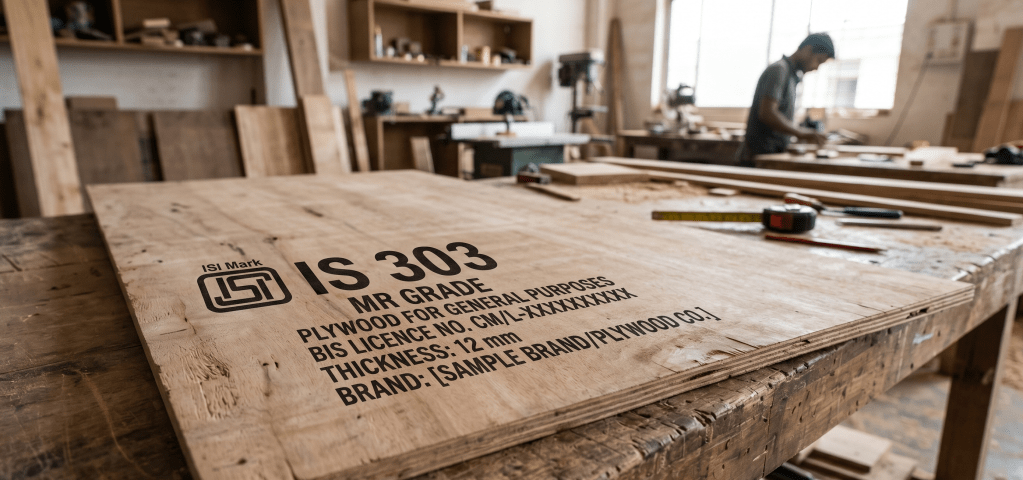
This guide explains the major ISI standards for plywood in simple terms, including IS 303 for general-purpose plywood, IS 710 for marine-grade plywood, IS 10701 for structural plywood, and IS 5509 for fire-retardant plywood. We’ll also help you understand how to verify an ISI mark, compare plywood grades, and choose the right plywood for kitchens, wardrobes, bathrooms, offices, and commercial interiors.
What are ISI standards for Plywood? Why Do They Matter?
ISI standards for plywood are quality benchmarks set by the Bureau of Indian Standards. They define how plywood should be made, tested, classified, marked, and supplied.
For buyers, the ISI mark helps answer one basic question: Is this plywood actually tested for quality, or is it just being sold with a claim?
What does an ISI standard check in plywood?
ISI standards do not judge plywood only by appearance. They look at multiple quality factors that affect strength and durability.
| Quality Factor | Why It Matters |
| Veneer quality | Affects the strength and finish of the plywood |
| Adhesive bonding | Helps the layers stay intact over time |
| Moisture resistance | Reduces swelling, warping, and damage in damp areas |
| Thickness tolerance | Helps with proper fitting, finishing, and furniture alignment |
| Core construction | Reduces gaps, weak spots, and uneven strength |
| Surface quality | Affects polishing, laminating, and visible finish |
For example, IS 303 applies to plywood for general purposes. It covers grades, surface types, materials, manufacturing rules, dimensions, tolerances, workmanship, sampling, testing, marking, and delivery.
Why does ISI standard matter when buying plywood?
A bedroom wardrobe does not face the same conditions as a kitchen cabinet. A bathroom vanity needs better moisture resistance than wall paneling. Office partitions may not need the same grade as outdoor furniture.
This is where ISI standards help. They make it easier to match plywood with the right use case.
| Use Case | Why ISI Grade Matters |
| Kitchen cabinets | Needs better resistance to moisture and steam |
| Bathroom vanities | Needs stronger water resistance |
| Wardrobes | Needs stable plywood for long-term indoor use |
| Beds and sofas | Needs strength and reliable bonding |
| Wall paneling | Needs surface finish and dimensional stability |
| Office furniture | Needs consistent quality and durability |
ISI marks also reduce confusion in the market
Many plywood boards are sold using terms like “premium,” “waterproof,” “commercial,” or “heavy quality.” These terms can be vague if they are not backed by proper certification.
An ISI-marked board gives buyers more specific information. Under IS 303, plywood boards must be marked with details such as the source of manufacture, year of manufacture, batch number, and grade/type such as BWR/AA, BWR/AB, MR/AA, or MR/BB.
So, instead of relying only on verbal claims, buyers can check the grade, type, and marking before making a decision.
Major ISI Standards for Plywood in India
Not all plywood is made for the same purpose. Some plywood is meant for regular furniture, some for wet areas, some for heavy-duty construction, and some for spaces where fire safety matters.
That is why plywood is covered under different ISI standards:-
| ISI Standard | Plywood Type | Common Use |
| IS 303 | General-purpose plywood | Wardrobes, beds, sofas, partitions, wall panels |
| IS 710 | Marine-grade / BWP plywood | Kitchens, bathrooms, outdoor furniture, high-moisture areas |
| IS 10701 | Structural plywood | Load-bearing and construction-related use |
| IS 5509 | Fire-retardant plywood | Commercial interiors and fire-sensitive areas |
1. IS 303: General-Purpose Plywood
IS 303 is one of the most commonly used plywood standards in India. It applies to plywood used for general purposes and covers requirements for grades, surface types, materials, manufacturing, dimensions, tolerances, workmanship, testing, marking, and delivery.
Under IS 303, plywood is divided into two main grades:
| Grade | Full Form | Best Used For |
| MR Plywood | Moisture Resistant | Dry interior furniture and basic indoor use |
| BWR Plywood | Boiling Water Resistant | Interior furniture where occasional moisture exposure is possible |
MR plywood is commonly used for wardrobes, beds, wall paneling, shelves, and indoor furniture. It can handle limited moisture but should not be used in areas with regular water exposure.
BWR plywood offers better resistance to moisture than MR plywood. It is a better choice for areas like kitchens, utility spaces, and furniture that may face occasional dampness.
2. IS 710: Marine Grade or BWP Plywood
IS 710 is used for marine-grade plywood, commonly known as BWP plywood. BWP stands for Boiling Water Proof.
This plywood is designed for areas where moisture exposure is much higher. It is commonly used in:
| Space | Why IS 710 Works Better |
| Kitchen cabinets | Handles moisture, spills, and steam better |
| Bathroom vanities | Performs better in damp conditions |
| Outdoor furniture | Offers better resistance to weather exposure |
| Utility areas | Suitable where water contact is more frequent |
IS 710 plywood is usually more expensive than general-purpose plywood. But for moisture-heavy areas, it can save money in the long run by reducing swelling, delamination, and replacement issues.
3. IS 10701: Structural Plywood
IS 10701 applies to structural plywood. This type of plywood is made for strength-based applications where load-bearing capacity matters.
It is usually not required for regular home furniture. It is more relevant for construction, industrial, or heavy-duty use.
| Where It Is Used | Why It Matters |
| Construction support | Needs load-bearing strength |
| Heavy-duty platforms | Needs better strength and stability |
| Industrial applications | Needs higher mechanical performance |
| Structural panels | Needs dependable bonding and density |
For a normal wardrobe, bed, or wall panel, IS 303 plywood is usually enough. But where plywood has to carry higher loads, structural plywood becomes more relevant.
4. IS 5509: Fire-Retardant Plywood
IS 5509 applies to fire-retardant plywood. This plywood is treated to slow the spread of fire and improve safety in specific spaces.
It is commonly considered for:
| Space | Why Fire-Retardant Plywood Helps |
| Offices | Supports safer interior planning |
| Commercial buildings | Useful where fire safety requirements are stricter |
| Hotels and public spaces | Helps reduce flame spread risk |
| Kitchens and service areas | Useful where heat exposure is higher |
| Schools and institutions | Helps meet safety-focused material choices |
Fire-retardant plywood is not needed for every project. But in commercial interiors or safety-sensitive spaces, it can be a better material choice than regular plywood.
Here’s a quick way to remember plywood standards:-
| Need | Standard to Consider |
| Regular indoor furniture | IS 303 MR or BWR |
| Kitchen or bathroom furniture | IS 710 BWP or high-quality BWR |
| Outdoor or high-moisture use | IS 710 BWP |
| Load-bearing use | IS 10701 |
| Fire-sensitive spaces | IS 5509 |
IS 710 vs IS 303: What is the Difference?
IS 710 and IS 303 are two of the most common plywood standards buyers come across in India. Both are used for different purposes, so the right choice depends on where the plywood will be installed.
1. IS 303 plywood
IS 303 covers plywood for general purposes. It is commonly used for home and office furniture such as wardrobes, beds, sofas, shelves, partitions, wall panels, and TV units.
Under IS 303, plywood is classified into two grades based on the bond strength of the adhesive used between veneers: BWR grade and MR grade. BWR stands for Boiling Water Resistant, while MR stands for Moisture Resistant.
MR plywood works well for dry interiors where the chances of water exposure are low. BWR plywood offers better moisture resistance and is more suitable for areas where the furniture may face occasional dampness.
For example, MR plywood can be used for a bedroom wardrobe. But if you are making furniture near a kitchen wall, utility space, or wash area, BWR plywood is usually a better choice.
2. IS 710 plywood
IS 710 is commonly linked with marine-grade plywood or BWP plywood. BWP stands for Boiling Water Proof.
This plywood is made for spaces where moisture exposure is much higher. It is often used for kitchen cabinets, bathroom vanities, sink areas, utility rooms, and outdoor furniture.
The main reason buyers choose IS 710 plywood is water resistance. In areas where regular plywood may swell, separate, or weaken over time, IS 710 plywood gives better protection.
It is usually more expensive than IS 303 plywood, but the higher cost can make sense in wet or damp areas. Replacing damaged kitchen or bathroom furniture later often costs more than choosing the right plywood at the beginning.
A quick comparison between IS 303 vs IS 710:-
| Factor | IS 303 Plywood | IS 710 Plywood |
| Common use | General furniture and interiors | Wet and high-moisture areas |
| Common grade | MR and BWR | BWP |
| Best for | Wardrobes, beds, panels, partitions | Kitchens, bathrooms, outdoor furniture |
| Water resistance | Moderate to good, based on grade | Higher |
| Cost | More budget-friendly | Usually higher |
Which one should you choose between IS 303 and IS 710?
Choose IS 303 MR plywood for regular indoor furniture where water exposure is not expected. It is suitable for wardrobes, beds, wall panels, and basic office furniture.
Choose IS 303 BWR plywood when you want better moisture resistance for interior use. It is a practical choice for furniture that may face occasional dampness.
Choose IS 710 BWP plywood for kitchens, bathrooms, sink cabinets, utility areas, and outdoor furniture. These spaces need stronger protection against moisture.
So, IS 710 is not always necessary for every project. For most dry interior furniture, IS 303 is enough. But for moisture-heavy areas, IS 710 is the safer long-term choice.
Key Plywood Quality Checks Under ISI Standards
ISI standards define plywood grades and also explain how plywood should be checked for performance, finish, bonding, and stability.
A board may look fine from the surface but may still have poor glue bonding, uneven thickness, core gaps, or high moisture content. Look for these criteria while looking for plywood ISI standards:-
1. Thickness and Size Tolerance
Thickness matters because plywood is used in furniture, paneling, partitions, cabinets, and modular fittings. If the thickness is uneven, the final work may have alignment issues, gaps, or poor finishing.
Under IS 303, plywood boards must follow specified thickness and tolerance limits. The standard mentions common board thicknesses based on the number of plies. It also gives tolerance limits for length, width, thickness, squareness, and edge straightness.
For buyers, this simply means that plywood should not vary too much from the size and thickness promised by the seller. Even small differences can affect carpentry work, especially in modular furniture.
2. Glue Bonding
Glue bonding is one of the most important quality checks in plywood. Plywood is made by bonding multiple veneers together. If the adhesive quality is poor, the layers can separate over time.
This is called delamination.
In IS 303, the grade of plywood depends on the bond strength developed by the adhesive used for bonding the veneers. The standard classifies plywood into BWR and MR grades based on this bonding performance.
BWR plywood is made for better resistance to water exposure. MR plywood is made for moisture resistance in general interior use. So, when you choose between MR and BWR, you are mainly choosing based on how much moisture and stress the bonding needs to handle.
3. Moisture Content
Moisture content affects the long-term stability of plywood. If plywood contains too much moisture, it can swell, warp, or lose shape after installation.
According to IS 303, plywood tested under the relevant method should have moisture content of not less than 5 percent and not more than 15 percent.
This range helps ensure the board is not too dry or too wet. Both extremes can affect performance. For furniture buyers, this check is important because moisture-related issues often appear after polishing, laminating, or installation.
4. Core Construction and Gaps
A plywood sheet is only as strong as its core. If the inner layers have gaps, overlaps, or poor veneer placement, the board can become weak even when the surface looks good.
IS 303 gives requirements for veneer assembly, grain direction, joints, and permissible defects. It also states that overlap is not permitted, and gaps in cores and cross-bands are allowed only within defined limits.
For a buyer, this means you should avoid plywood that feels hollow, has uneven edges, or shows visible gaps when cut. These signs can point to weak internal construction.
5. Surface Quality and Finish
Surface quality matters when plywood is used for visible furniture, polishing, laminates, veneers, or wall panels.
IS 303 classifies plywood by appearance into AA, AB, and BB types. This is based on the quality of the face and back surfaces. The standard also lists permissible surface defects and limits the number of defect categories allowed on a panel surface.
This does not mean every plywood sheet must look perfect. It means the surface quality should match the declared grade and type. For premium visible work, buyers should prefer better surface grades. For hidden or back-end use, a lower surface type may still be practical.
6. Strength and Long-Term Performance
Good plywood should stay stable after cutting, fixing, polishing, laminating, and regular use. ISI testing helps check whether the plywood can handle stress, moisture, bending, and daily wear.
The later amendments to IS 303 also include static bending strength requirements, including Modulus of Elasticity and Modulus of Rupture values for BWR and MR grades. These tests help assess how the board performs under bending load.
For regular buyers, the takeaway is simple: certified plywood is not just about a stamp. It should meet defined checks for bonding, moisture, thickness, surface quality, and strength. That is what makes the ISI mark useful when comparing plywood options.
How to Verify an ISI Mark on Plywood Before Buying
An ISI mark is useful only when it is genuine. A board may carry words like “ISI quality” or “as per ISI standards,” but that is not the same as a properly certified product.
Before buying plywood, check the board carefully and ask the seller for clarity if any marking is missing.
1. Check the IS standard number
The first thing to check is the standard number printed on the plywood sheet.
For general-purpose plywood, the board should mention IS 303. This standard covers plywood used for general purposes and includes grades such as BWR and MR.
If you are buying plywood for a kitchen, bathroom, or damp area, you may come across IS 710, which is used for marine-grade or BWP plywood. For fire-retardant plywood, look for the relevant fire-retardant standard.
The number matters because each standard is meant for a different type of plywood. A board marked IS 303 should not be sold as marine-grade plywood unless it also meets the correct standard for that use.
2. Check the grade and type marking
Under IS 303, plywood boards must be marked with their grade and type. The standard mentions markings such as BWR/AA, BWR/AB, BWR/BB, MR/AA, MR/AB, and MR/BB.
This tells you two things:
| Marking Part | What It Tells You |
| BWR or MR | The moisture-resistance grade of the plywood |
| AA, AB, or BB | The surface quality of the face and back |
For example, BWR/AA means the plywood is Boiling Water Resistant and has A-quality surfaces on both sides. MR/BB means the plywood is Moisture Resistant and has B-quality surfaces on both sides.
This helps you avoid paying for a higher grade when the board is actually meant for a lower-use application.
3. Look for manufacturer, year, and batch details
A proper plywood board should not only have the grade. It should also carry basic manufacturing information.
As per IS 303, each plywood board should be marked with the source of manufacture, year of manufacture, batch number, and grade/type. These markings should be made on the face of the board near one corner.
These details matter because they make the product traceable. If there is a quality issue later, batch and manufacturer details help identify where the plywood came from.
4. Verify the CM/L number
A genuine BIS-certified product usually carries a licence number, often shown as a CM/L number. This number can be checked through BIS sources such as the BIS Care App or the BIS website.
When checking the CM/L number, make sure the licence belongs to the same manufacturer and product category. Do not rely only on the seller’s word.
5. Be careful with vague claims
Some sellers may use terms that sound convincing but do not prove certification. Be cautious with phrases like:
- “ISI-type plywood”
- “ISI quality”
- “Made as per ISI”
- “Equivalent to marine plywood”
- “Waterproof commercial plywood”
These claims should be checked against the actual marking on the board.
A genuine ISI-marked plywood sheet should clearly mention the relevant standard, grade, type, and manufacturing details. If the markings are unclear, missing, or inconsistent, it is better to ask questions before buying.
Before finalizing plywood, use this simple checklist:
| Checkpoint | What to Look For |
| IS standard number | IS 303, IS 710, or other relevant standard |
| Grade | MR, BWR, or BWP, depending on use |
| Type | AA, AB, or BB for surface quality |
| Manufacturer details | Source of manufacture printed clearly |
| Batch and year | Helps with product traceability |
| CM/L number | Can be verified through BIS sources |
| Seller credibility | Buy from a trusted dealer or supplier |
Get the Right ISI-Grade Plywood with Digna Ply
At Digna Ply, we help you choose plywood based on actual use, not just price or generic grade names. The right plywood for a bedroom wardrobe may not be the right plywood for a kitchen, bathroom, office, or commercial space.
For regular indoor furniture, you may need good-quality MR or BWR plywood. For moisture-prone areas like kitchens, sink cabinets, utility spaces, and bathrooms, you may need stronger water resistance. For offices and shops, the focus may be on durability, finish, and long-term value.
The goal is simple: buy plywood that fits the job. Overpaying for the wrong grade is not useful. At the same time, saving money with a lower grade in a wet area can lead to swelling, repairs, and replacement costs later.
If you are unsure which plywood grade to choose, speak to Digna Ply before finalizing the material. We can help you compare options and pick plywood suited for your furniture, location, and budget.
For plywood inquiries, WhatsApp Digna Ply at 8881306046 and get help choosing the right grade for your project.
Frequently Asked Questions
What is ISI standard plywood?
ISI standard plywood is plywood manufactured and tested according to standards set by the Bureau of Indian Standards. These standards define requirements such as grade, bonding quality, thickness tolerance, surface type, testing method, and marking.
What is the difference between IS 303 and IS 710 plywood?
IS 303 is used for general-purpose plywood. It is commonly used for indoor furniture such as wardrobes, beds, panels, shelves, and office furniture.
IS 710 is used for marine-grade or BWP plywood. It is better suited for areas with higher moisture exposure, such as kitchens, bathrooms, sink cabinets, utility spaces, and outdoor furniture.
Is IS 710 plywood the same as marine plywood?
Yes, IS 710 is generally associated with marine-grade plywood in India. It is also commonly called BWP plywood, which means Boiling Water Proof.
It is designed for better water resistance than regular interior-grade plywood.
Is IS 303 plywood good for furniture?
Yes, IS 303 plywood is suitable for many furniture applications. It is commonly used for wardrobes, beds, sofas, shelves, wall panels, partitions, and office furniture.
Under IS 303, plywood is classified into BWR and MR grades based on adhesive bond strength. BWR offers better moisture resistance, while MR is suitable for dry interior use.
What is the difference between MR, BWR, and BWP plywood?
MR stands for Moisture Resistant. It is suitable for dry interiors where water exposure is low.
BWR stands for Boiling Water Resistant. It offers better moisture resistance than MR plywood and is useful for furniture that may face occasional dampness.
BWP stands for Boiling Water Proof. It is used for higher-moisture applications and is commonly linked with marine-grade plywood.
How can I check whether plywood is BIS certified?
Check the plywood sheet for the correct IS standard number, grade, type, manufacturer details, year of manufacture, and batch number.
For IS 303 plywood, the board should be marked with details such as source of manufacture, year, batch number, and grade/type like BWR/AA, BWR/AB, MR/AA, or MR/BB.
You can also verify the licence or CM/L number through BIS sources such as the BIS Care App or BIS website.
Which ISI plywood is best for wardrobes?
For bedroom wardrobes, IS 303 MR plywood can work well in dry interiors. If the wardrobe is placed near a damp wall or in a humid area, IS 303 BWR plywood is a better option.
The right choice depends on moisture exposure, budget, and expected life of the furniture.


Leave a Reply