For most wardrobes in India, 18mm plywood is commonly used for structural parts such as side panels, shelves, partitions, and sometimes shutters, while thinner sheets can be used for back panels and drawer bottoms. The plywood grade matters just as much. MR plywood may work in a dry bedroom, while BWR or BWP plywood provides better protection where humidity, damp walls, attached bathrooms, or seasonal moisture are concerns. Blockboard, MDF, and HDHMR can also make sense for selected parts such as tall shutters or decorative panels.
In this article, we’ll compare different plywood grades, discuss the right wardrobe plywood thickness for different components, compare plywood with blockboard, MDF, and HDHMR, and look at the factors that affect plywood prices. We’ll also cover how climate conditions in different parts of India can affect your choice and what to check before buying plywood for a new wardrobe or almirah.
Which Plywood is Best for Wardrobes and Cupboards?
For most wardrobes, BWR or BWP plywood is a safer choice than standard MR plywood, especially when the wardrobe is placed against an exterior wall, near an attached bathroom, or in a room where humidity and dampness may be an issue. MR plywood can still work in dry bedrooms, but it offers less protection if moisture reaches the board.
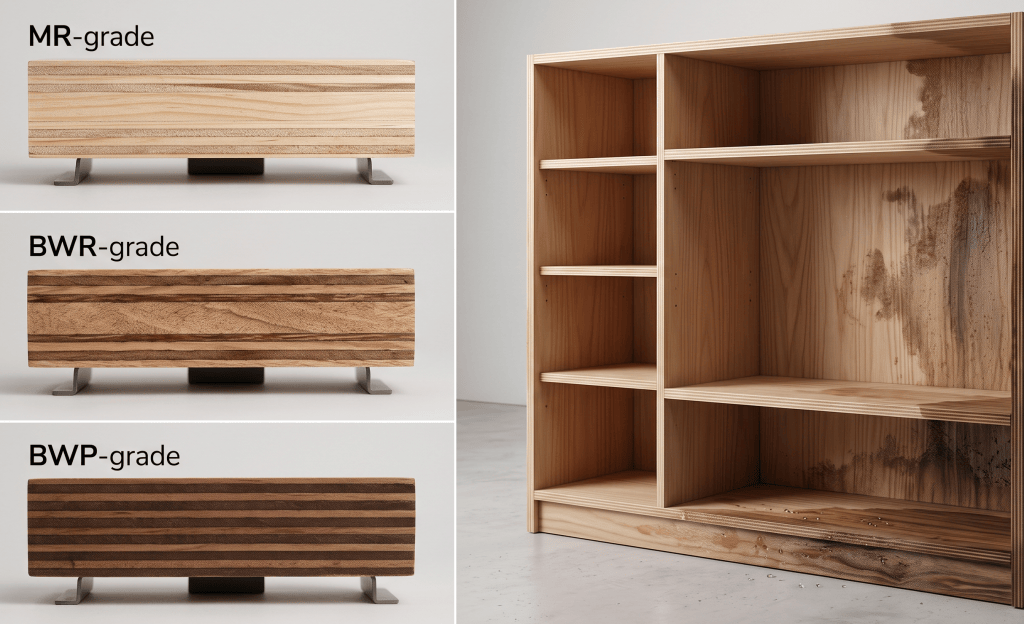
Here is a simple comparison of plywood grades used in wardrobes:
| Plywood Grade | Moisture Resistance | Best Use in Wardrobes | Relative Cost |
| MR plywood | Basic | Dry bedroom wardrobes and low-risk internal sections | Lower |
| BWR plywood | Good | General wardrobe carcasses, shelves, and partitions | Medium |
| BWP plywood | High | Wardrobes near damp walls, bathrooms, exterior walls, or humid areas | Higher |
Can We Use MR-Grade Commercial Plywood for Wardrobes?
Yes, MR grade commercial plywood can be used for wardrobes in dry bedrooms, especially when there is little risk of wall seepage, floor moisture, or consistently high humidity. It is usually more affordable than BWR or BWP plywood, which makes it useful for budget-focused wardrobe construction.
MR plywood works best when:
- The wardrobe is placed against an internal wall with no history of dampness.
- The bedroom does not have persistent humidity problems.
- The wardrobe is away from bathrooms or other moisture-prone areas.
- The plywood is being used for relatively dry internal sections.
Its main limitation is moisture resistance. If water or dampness reaches the board repeatedly, MR plywood is more likely to develop swelling, fungal growth, or bonding issues compared with BWR or BWP plywood.
A mixed-material approach can also help manage cost. For example, BWP or BWR plywood can be used for the wardrobe base, wall-facing sides, and other higher-risk areas, while MR plywood can be considered for dry internal sections where moisture exposure is unlikely.
When Should You Use BWP Plywood for a Wardrobe?
BWP plywood is worth considering when the wardrobe has a higher chance of being exposed to moisture. According to the supplied brief, it is made using phenol formaldehyde synthetic resin, which gives it stronger bonding and better resistance to moisture than MR-grade plywood.
BWP plywood is particularly suitable when:
- The wardrobe is built against an exterior wall that may become damp during the monsoon.
- The bedroom has an attached bathroom, and humidity regularly remains high.
- The wardrobe is on the ground floor, where walls or floors are more likely to develop moisture.
- The home is located in a humid or coastal region.
- The wardrobe base or back panel may come into contact with moisture from the floor or wall.
- You want better moisture protection for structural sections that would be difficult to replace later.
It is not always necessary to use BWP plywood for every internal section of a wardrobe. In a largely dry room, homeowners can use BWP in higher-risk areas and consider BWR plywood for other sections. This can help control the overall wardrobe cost without reducing protection where moisture is most likely to cause damage.
Choose MR plywood when budget matters and the wardrobe will remain in a dry room. BWR plywood gives better moisture resistance and is suitable for most regular wardrobes. BWP plywood offers the highest moisture protection among these three grades and is better suited to areas where dampness is more likely.
What is the Ideal Plywood Thickness for a Wardrobe?
Wardrobe plywood thickness should vary by component. Using 18mm plywood everywhere can make the wardrobe heavier and more expensive, while using thinner sheets in structural areas can lead to bending or weak joints over time. That’s why use 18 mm plywood for the main frame and shelves, with thinner sheets for drawers, partitions, and back panels where the load is lower.
| Wardrobe Component | Recommended Plywood Thickness |
| Outer frame and side panels | 18mm |
| Main shelves | 18mm |
| Internal partitions | 12mm to 18mm |
| Drawer sides | Around 12mm |
| Drawer bottoms | 6mm to 9mm |
| Back panel | 6mm to 9mm |
| Hinged shutters | Usually around 18mm, depending on size and design |
For long shelves, thickness alone is not enough. A wide shelf carrying heavy clothes, boxes, or other items may still bend if it does not have enough support underneath. In such cases, the carpenter may need to reduce the shelf span or add additional support.
Similarly, back panels and drawer bottoms generally do not need 18mm plywood because they are not carrying the same structural load as the wardrobe frame.
Is 18mm Plywood Good for Wardrobes?
Yes, 18mm plywood is commonly used for the main structural parts of a wardrobe because it provides enough thickness for shelves, side panels, partitions, and other sections that need to carry weight or hold hardware securely. The supplied brief also treats 18mm as the standard choice for major wardrobe components.
It is commonly used for:
- Side panels and the main wardrobe frame.
- Top and bottom panels.
- Main shelves that carry clothes, boxes, and accessories.
- Vertical partitions between wardrobe sections.
- Many hinged shutter designs, depending on their height and width.
However, using 18mm plywood throughout the entire wardrobe is usually unnecessary. Back panels and drawer bottoms can often be made with thinner plywood because they do not carry the same load as the frame or shelves.
The quality and grade of the plywood also matter. An 18mm MR sheet and an 18mm BWP sheet may have the same thickness, but they do not provide the same moisture resistance. Shelf length, expected load, hardware weight, and support placement should also be considered before deciding that thickness alone is enough.
Plywood vs Blockboard for Wardrobe Shutters
Plywood and blockboard can both be used for wardrobe shutters, but they behave differently over long vertical spans. Plywood offers good strength and screw-holding capacity, which makes it suitable for hinges, handles, and other wardrobe hardware. It also works well for standard-sized hinged shutters where the height and weight remain manageable.
For very tall shutters, however, the final performance depends on plywood quality, shutter size, laminate weight, and hardware placement. A long shutter can still develop alignment issues if the material or construction is poor.
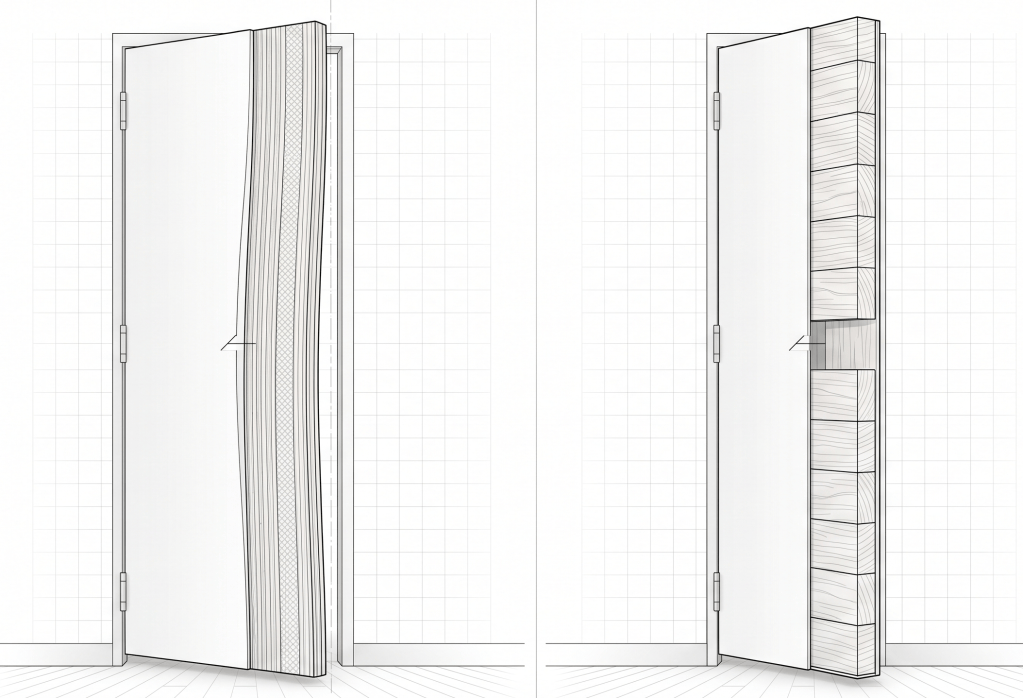
Blockboard is made with strips or blocks of wood placed between veneer layers. According to the supplied brief, this construction can make it a better option for long wardrobe shutters where resistance to bending is an important consideration.
Blockboard may be preferred for:
- Tall hinged wardrobe doors.
- Long vertical shutters where straightness matters.
- Designs where reducing shutter weight is useful.
- Large shutters that may place more stress on hinges.
For the main wardrobe body, plywood remains the more practical choice because shelves, partitions, and side panels need structural strength and good hardware holding. For tall shutters, blockboard can be considered when the design calls for a long vertical panel and controlling warpage is a priority.
The final choice should also account for shutter height, width, finish, hinge quality, and expected weight rather than selecting the board material alone.
Plywood vs MDF vs HDHMR for Modular Wardrobes
MDF, plywood, and HDHMR are all used in modular wardrobes, but they are not suited to the same jobs. The supplied brief recommends plywood for the main wardrobe structure because of its durability, load-bearing ability, and screw-holding strength, while MDF and HDHMR are often considered for shutters, routed designs, and decorative surfaces.
| Material | Moisture Resistance | Screw Holding | Structural Strength | Surface Finish | Common Wardrobe Use |
| Plywood | Varies by grade | Strong | Strong | Good | Carcass, shelves, partitions, shutters |
| MDF | Lower | Moderate | Lower than plywood | Very smooth | Decorative panels and routed shutters |
| HDHMR | Better than standard MDF | Better than MDF | Good | Very smooth | Shutters and decorative applications |
i) Plywood
Plywood is generally the better choice for the main wardrobe carcass. It works well for side panels, shelves, partitions, and sections where hinges, channels, or other hardware need to remain firmly fixed for years.
BWR and BWP plywood also provide better moisture protection than standard MDF, which makes them more suitable for wardrobes near damp walls or in humid rooms.
ii) MDF
MDF has a smooth and uniform surface, which makes it suitable for painted, routed, or decorative wardrobe designs. It is also often more budget-friendly than good-quality plywood.
However, standard MDF is more sensitive to moisture and generally does not hold screws as strongly as plywood. For this reason, it is better suited to selected decorative sections rather than heavily loaded structural areas.
iii) HDHMR
HDHMR is denser and more moisture-resistant than standard MDF. Its smooth surface makes it suitable for routed shutters, laminates, acrylic finishes, and other decorative applications.
It can be a practical choice for wardrobe shutters where surface flatness and finish quality matter. However, the supplied brief notes that plywood still has an advantage when strong screw holding is required, especially for heavy hardware.
For the main wardrobe body, plywood is usually the safer option. MDF can work for decorative elements in dry areas, while HDHMR can be considered for shutters and finished panels where a smooth, flat surface is important.
Which Material Is Better for Sliding Wardrobe Doors?
Sliding wardrobe doors need a slightly different material choice because the shutter moves on a track and usually covers a much larger vertical area than a normal cabinet door. The supplied brief highlights warpage, surface flatness, and hardware holding as the main factors to consider for large sliding shutters.
Plywood works well when strong screw holding is important, especially around sliding hardware and fittings. BWR or BWP plywood can also provide better protection where moisture is a concern.
HDHMR, on the other hand, offers a very flat and smooth surface. This can make it suitable for large shutters finished with acrylic, laminate, paint, or other decorative materials where an even surface is important. According to the brief, HDHMR can perform well for large sliding doors, but plywood still has an advantage where stronger hardware holding is required.
The final choice should take more than the board type into account. Consider:
- The height and width of the sliding shutter.
- The total weight of the board and decorative finish.
- The quality and load capacity of the track and rollers.
- The number and placement of hardware fixing points.
- The likelihood of moisture exposure.
- The need for a completely flat surface for acrylic or laminate finishes.
For large sliding wardrobes, it is better to select the shutter material together with the sliding hardware system rather than deciding on the board first and fitting the hardware later.
Does Climate Affect the Plywood You Should Use for a Wardrobe?
Yes. Local humidity and the condition of the room can affect which plywood grade is suitable for a wardrobe. The supplied brief separates high-moisture coastal regions from relatively dry inland regions because wardrobes in humid locations face a greater risk of dampness, fungal growth, and moisture reaching the board through walls or floors.
i) Humid and Coastal Regions
In cities such as Mumbai, Chennai, and Kolkata, year-round humidity and long monsoon periods can increase moisture exposure inside homes. For wardrobes in such conditions, BWR or BWP plywood is generally a better choice than MR plywood, particularly for the base, side panels, and sections placed against walls.
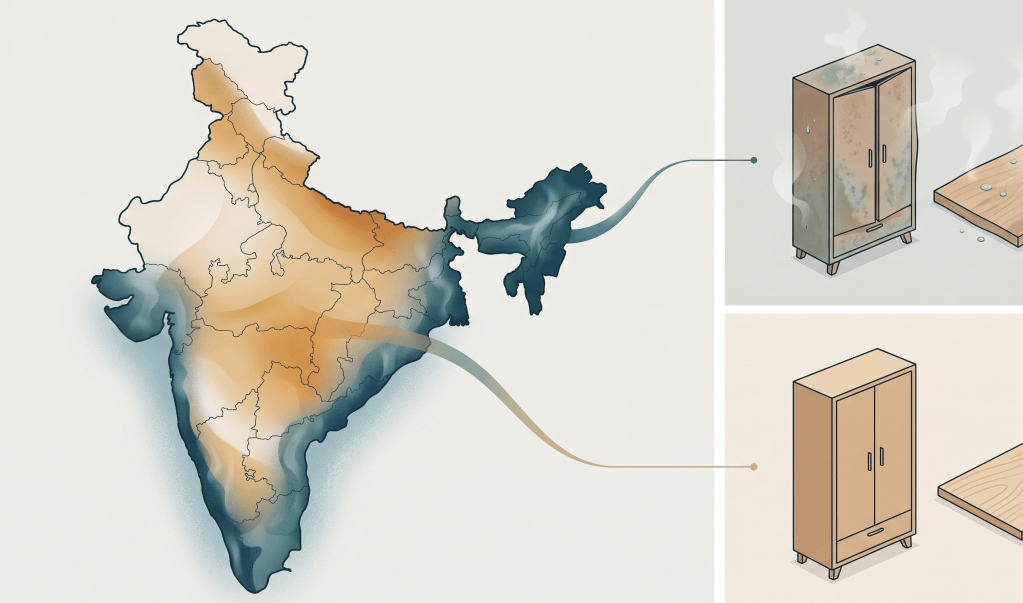
BWP plywood becomes more useful when the wardrobe is close to an attached bathroom, exterior wall, or an area with a history of seepage.
ii) Relatively Dry Inland Regions
In cities such as Delhi, Jaipur, Lucknow, and Bhopal, MR or BWR plywood may be suitable for wardrobes in dry bedrooms. However, the condition of the specific room matters more than the city’s general climate.
For example, a wardrobe in a dry city can still face moisture problems if it is placed against a damp exterior wall or beside an attached bathroom. In that case, moving to BWR or BWP plywood for vulnerable sections can be a better decision.
How to Check Plywood Quality Before Building a Wardrobe
Even the right plywood grade can perform poorly if the sheet itself has weak bonding, uneven thickness, core gaps, or visible warping. Before the carpenter starts cutting the material, it is worth checking a few basic quality points. The supplied brief specifically recommends inspecting the core, certification, sheet flatness, and thickness consistency.
Here are a few simple steps to check the quality of plywood:
i) Check the plywood grade and certification – Confirm whether the sheet is MR, BWR, or BWP and inspect the product markings before purchase.
ii) Inspect the sheet edges for core gaps – Large empty spaces between inner layers can weaken the board and affect screw holding.
iii) Check whether the sheet is flat – Place the plywood on a flat surface and look for visible bending, twisting, or uneven corners.
iv) Measure the thickness at different points – The brief recommends checking all four corners with a caliper to make sure the thickness is reasonably consistent.
v) Inspect the face veneer – Look for cracks, damaged patches, excessive repairs, or other visible surface defects.
vi) Check the manufacturer and product details – Do not rely only on the dealer’s description. Confirm the brand, grade, thickness, and product specifications printed on the sheet or packaging.
vii) Match the plywood to its intended use – A good-quality MR sheet may still be the wrong choice for a moisture-prone wardrobe. Quality checks and grade selection need to work together.
Common Mistakes to Avoid When Buying Plywood for Wardrobes
A wardrobe can fail early even when the plywood looks good at the time of purchase. Many problems come from choosing the wrong grade, thickness, or material for a specific component. The supplied brief points to moisture exposure, warping, sagging shelves, and weak hardware holding as common concerns.
Here are some mistakes worth avoiding:
Mistake 1: Using the same plywood thickness everywhere can add unnecessary cost and weight – Structural sections may need 18mm plywood, while back panels and drawer bottoms can usually use thinner sheets.
Mistake 2: Choosing plywood only by price can lead to poor material selection – Compare the grade, core quality, certification, thickness, and intended use before comparing cost.
Mistake 3: Using MR plywood against a damp wall can increase the risk of moisture damage – BWR or BWP plywood is a better option for areas where seepage or humidity is more likely.
Mistake 4: Ignoring shelf span can result in sagging – Even 18mm plywood may bend when a long shelf carries heavy items without enough support.
Mistake 5: Selecting shutter material without considering door height can cause alignment problems – Tall shutters may need a different material or construction approach than smaller cabinet doors.
Mistake 6: Ignoring hardware quality can reduce the life of the wardrobe – Hinges, drawer channels, sliding tracks, and fixing points should be selected according to the weight and size of the panels.
Mistake 7: Using MDF or HDHMR in every section simply because the surface looks smoother can be a poor structural choice – Decorative finish and structural strength should be treated separately.
Mistake 8: Skipping plywood inspection before cutting can make defects harder to correct later – Check the sheet for core gaps, uneven thickness, bending, and product markings before installation.
Choose Digna Ply for Wardrobe Plywood
Digna Ply helps customers select suitable plywood for different wardrobe sections based on moisture exposure, structural requirements, and budget.
You can also purchase wardrobe hardware such as hinges, drawer channels, sliding fittings, handles, and other accessories along with the plywood. This makes it easier to match the board with the hardware being used in the final wardrobe design.
For wardrobe plywood and hardware in Dehradun, call or WhatsApp Digna Ply at 8881306046.
Frequently Asked Questions
Which plywood is best for a wardrobe in India?
BWR plywood is suitable for many regular bedroom wardrobes, while BWP plywood is a better option when the wardrobe is near a damp wall, attached bathroom, exterior wall, or humid environment. MR plywood can work in consistently dry rooms.
Is 18mm plywood enough for a wardrobe?
Yes. The supplied brief recommends 18mm plywood for major structural components such as the outer frame, side panels, main shelves, and many partitions. Thinner plywood can be used for back panels, drawer bottoms, and other lighter sections.
Is BWP plywood necessary for bedroom wardrobes?
Not always. In a dry bedroom with no moisture problems, BWR or even MR plywood may be suitable depending on the application. BWP becomes more useful where humidity, seepage, damp walls, or nearby bathrooms increase moisture exposure.
Can MR grade plywood be used for wardrobes?
Yes, MR plywood can be used for wardrobes in dry environments. It is usually more affordable than BWR or BWP plywood, but it offers less protection against moisture.
Which is better for wardrobe shutters, plywood or blockboard?
Plywood works well for many standard-sized shutters because of its strength and screw holding. Blockboard may be considered for tall shutters where reducing the tendency to bend over a long vertical span is important.
Is MDF cheaper than plywood for wardrobes?
MDF is often positioned as a more budget-friendly option and provides a smooth surface for decorative work. However, plywood is generally better suited to structural sections because of its strength, moisture-resistant grade options, and screw holding.
Is HDHMR good for wardrobe shutters?
Yes, HDHMR can work well for wardrobe shutters, particularly when a smooth and flat surface is required for routed designs, laminates, acrylic, or other finishes. Plywood may still be preferred where stronger hardware holding is a priority.
What thickness should be used for a wardrobe back panel?
The supplied brief recommends approximately 6mm to 9mm plywood for wardrobe back panels. Using 18mm plywood for the back is generally unnecessary unless the wardrobe design has a specific structural requirement.


Leave a Reply