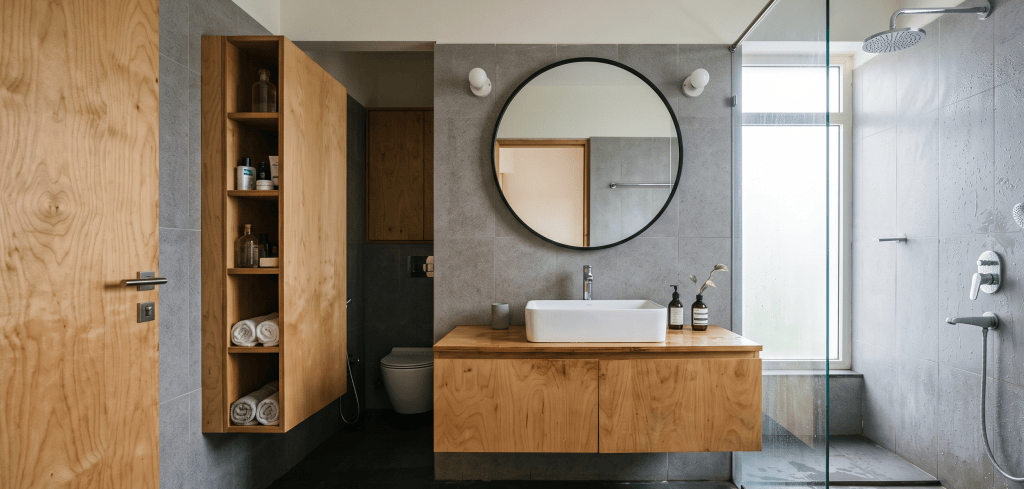
Bathrooms are among the toughest areas for plywood furniture because moisture comes from several directions. Water can splash from the shower or basin, steam can keep the room humid for long periods, and regular floor washing can repeatedly wet the lower edges of cabinets and doors. In compact Indian bathrooms, these risks increase because vanities, storage units, and doors are often positioned close to the bathing area.
Using regular commercial or MR-grade plywood in such conditions can lead to swelling, warping, delamination, rot, and mold over time. This is why bathroom furniture generally requires plywood designed for higher water resistance, such as BWP plywood and suitable IS 710 marine-grade plywood.
In this article, we’ll compare BWP, BWR, IS 710 marine plywood, HDHMR, and PVC boards for different bathroom applications. We’ll also look at the right material for cabinets, vanities, doors, and other furniture, along with waterproofing methods, approximate pricing, and checks to make before buying.
Which Plywood Is Best for Bathrooms?
For most bathroom furniture, BWP plywood is the safer choice because it is made to handle repeated moisture exposure better than regular MR or BWR plywood. In areas that face frequent splashes, such as under-sink cabinets, vanities, and bathroom doors, IS 710 marine-grade plywood can also be considered when you want a higher level of water resistance.
The right grade depends on how much water the furniture is likely to face:
- MR plywood is suitable for relatively dry interiors and should generally be avoided in bathroom areas that regularly come in contact with water.
- BWR plywood can handle moisture better than MR plywood and may work in semi-wet areas, but it is not the first choice for frequent splash zones.
- BWP plywood is better suited to bathrooms because its bonding system is designed to withstand prolonged moisture exposure.
- IS 710 marine-grade plywood is a strong option for high-moisture applications where the material may face repeated water exposure.
What Is BWP Plywood? Why is it Used in Bathrooms?
BWP stands for Boiling Water Proof plywood. It is built for applications where the board may face repeated moisture or water exposure, which makes it a better fit for bathrooms than standard interior plywood. The veneers are bonded using phenol formaldehyde resin, commonly referred to as phenolic resin, which provides stronger water resistance and reduces the chances of the layers separating when exposed to moisture.
In bathrooms, BWP plywood is commonly considered for vanity units, storage cabinets, mirror cabinets, shelves, and doors. It is especially useful around washbasins and lower cabinets where occasional leaks, floor washing, and regular splashes can expose the board to water.
Is IS 710 Plywood Suitable for Bathrooms?
Yes, IS 710 marine-grade plywood is suitable for bathroom applications, particularly for furniture placed in areas with frequent moisture exposure. The grade is intended for demanding conditions and is commonly associated with BWP plywood made using selected veneers and water-resistant bonding.
It can be considered for under-sink vanities, bathroom doors, cabinets close to shower areas, and other furniture where regular splashes are expected. That said, marine-grade plywood should not be treated as a board that can remain unfinished under continuous water contact. Surface finishing and edge protection still matter.
For many bathrooms, good-quality BWP plywood with correct installation may be sufficient. IS 710 marine-grade plywood becomes more relevant when the furniture is positioned in a wetter zone or when the buyer wants a higher moisture-resistance specification.
BWR vs BWP Plywood for Bathroom
BWR and BWP plywood are both designed to handle moisture better than regular MR-grade plywood, but they are not meant for the same level of exposure. For bathroom furniture, the difference matters because cabinets, vanities, and doors can face repeated splashes, condensation, and wet floors.
BWR stands for Boiling Water Resistant, while BWP stands for Boiling Water Proof. BWR plywood can work well in areas where moisture exposure is occasional, but BWP plywood is generally the better option when the board is likely to face frequent water contact.
| Factor | BWR Plywood | BWP Plywood |
| Water resistance | Good resistance to moisture and occasional water exposure | Better suited to repeated and prolonged water exposure |
| Bathroom suitability | Suitable for relatively dry or semi-wet areas | Better suited to wet and splash-prone areas |
| Common applications | Cabinets away from direct water, kitchen furniture, general interiors | Bathroom vanities, cabinets, doors, and wet-area furniture |
| Direct splash exposure | Not preferred for regular splashing | Better suited when properly sealed and finished |
| Bonding | Water-resistant adhesive system | Stronger water-resistant phenolic bonding |
| Relative price | Usually lower | Usually higher |
| Best use case | Areas where humidity is present but direct water contact is limited | Areas where regular moisture or splashing is expected |
For example, a wall-mounted bathroom cabinet positioned far from the shower may perform well with a good BWR board if the room is properly ventilated. However, for an under-sink vanity, lower cabinet, or bathroom door that regularly comes in contact with water, BWP plywood is the safer choice.
It is also important to remember that neither grade should be left unfinished. Water can still enter through cut edges, joints, screw holes, or poorly sealed surfaces. Proper laminate, edge sealing, and installation remain important even when using BWP plywood.
How to Choose Plywood for Different Bathroom Applications
The best plywood for a bathroom depends on where the furniture is installed and how often it comes in contact with water. A wall cabinet placed away from the shower has very different requirements from an under-sink vanity or a bathroom door that gets wet during floor washing.
i) Bathroom Cabinets
For bathroom cabinets, BWP plywood is generally the preferred option, especially when the unit is installed close to a basin, shower, or wet wall. It provides better protection against repeated moisture exposure than MR or BWR plywood.
Wall-mounted cabinets positioned away from direct splashes face lower risk, but they are still exposed to steam and condensation. The outer surfaces, inner panels, and especially the edges should therefore be properly covered with laminate, edge banding, or another suitable finish.
ii) Bathroom Vanity
For an under-sink vanity, the material needs to do more than resist moisture. It also needs enough strength to hold fittings, support hardware, and remain stable around plumbing cut-outs. BWP plywood, HDHMR, and PVC boards are all used for bathroom furniture, but they behave differently.
| Factor | BWP Plywood | HDHMR | PVC Board |
| Water resistance | High when properly finished and sealed | High moisture resistance | Very high resistance to water |
| Structural strength | Strong and suitable for load-bearing furniture | Dense and rigid | Generally lower than plywood for heavier applications |
| Screw-holding ability | Strong | Good | Can vary depending on board density and quality |
| Suitability below washbasin | Very good | Good | Good for highly wet areas |
| Surface finishing | Works well with laminates, veneers, and other finishes | Suitable for laminates and painted finishes | Often used directly or with decorative finishes |
| Fabrication | Familiar material for most carpenters | Requires suitable tools because of its density | Fabrication depends on the type of PVC board |
| Relative cost | Medium to high | Medium to high | Varies widely by quality |
| Best suited for | Strong vanity structures and cabinets | Moisture-prone cabinets and shutters | Areas where maximum resistance to direct water is the priority |
iii) Bathroom Door
Bathroom doors regularly face humidity, wet floors, and water splashes near the bottom edge. For this reason, MR-grade plywood is generally not the preferred choice for a bathroom door exposed to frequent moisture. The attached brief specifically recommends BWP for these wetter applications and flags MR plywood as unsuitable where repeated water contact is expected.
BWP plywood provides better protection for bathroom doors, particularly where floor washing causes the lower section to get wet repeatedly. The bottom and side edges should still be sealed properly because these areas often receive the most exposure.
iv) Mirror Frames and Bathroom Shelves
Mirror frames and upper shelves usually face humidity and condensation rather than constant direct water exposure. Good-quality BWP plywood works well for these applications, while the final choice may also depend on where the unit is positioned.
A shelf mounted beside a shower requires more protection than one installed above a dry countertop. The same principle applies to mirror cabinets. The closer the furniture is to a regular splash zone, the more important BWP grade, sealed edges, and proper surface finishing become.
How to Protect Bathroom Plywood From Swelling and Delamination
Even good BWP plywood can deteriorate faster if water repeatedly reaches exposed edges, joints, or cut-outs. Bathroom furniture therefore needs proper sealing and installation in addition to the right plywood grade.
A few practical measures can reduce the risk of swelling and delamination:
i) Seal all exposed edges properly. Cut plywood edges can absorb water faster than laminated surfaces, so they should be covered using suitable edge banding or another water-resistant finish.
ii) Use laminate on exposed surfaces. Laminate can create an additional barrier against splashes and condensation when applied correctly.
iii) Seal joints with silicone. Areas around washbasins, countertops, cabinet joints, and plumbing openings should be sealed to prevent water from entering small gaps.
iv) Protect plumbing cut-outs. Pipe openings often expose the inner layers of plywood. These edges should be sealed before the vanity is installed.
v) Keep cabinets above wet floors. Wall-mounted vanities or suitable legs can reduce direct contact with water during floor washing.
vi) Use inner lining where required. The inside of an under-sink cabinet may also face leaks and condensation, so protecting internal surfaces can help.
vii) Repair plumbing leaks quickly. A slow leak below the basin can keep plywood wet continuously, causing more damage than occasional surface splashes.
The most vulnerable areas are usually the bottom edges of cabinets, basin cut-outs, corners, hinge holes, and joints around plumbing. These areas deserve extra attention during installation rather than after visible swelling has already started.
How Bathroom Ventilation Affects Plywood
Bathroom ventilation directly affects how long plywood furniture stays dry after showers, floor washing, and regular use. In a poorly ventilated bathroom, steam and condensation can remain trapped for long periods, keeping cabinet surfaces, wall-facing panels, and joints damp even when they are not in direct contact with water.
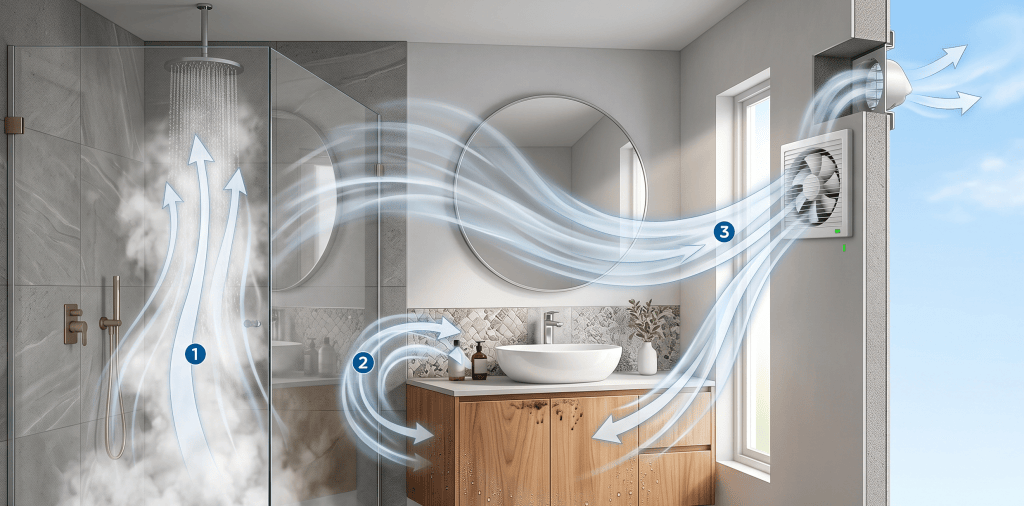
This is especially common in compact bathrooms with small windows or no natural cross-ventilation. Moisture can collect behind a vanity, around the back of a wall cabinet, and near corners where air movement is limited. Over time, these areas may develop mold, surface damage, or weakening around exposed edges and joints.
A few measures can reduce this risk:
- Use an exhaust fan regularly to remove humid air after bathing.
- Keep windows open when possible so the bathroom dries faster.
- Avoid installing cabinets tightly against walls where moisture regularly collects.
- Leave enough clearance below vanities and around storage units for air circulation.
- Wipe standing water around cabinets instead of allowing it to remain on the floor.
- Check hidden areas behind and below the vanity periodically for condensation or plumbing leaks.
Ventilation becomes even more important when plywood furniture is close to a shower or basin. BWP plywood can handle moisture better than lower grades, but keeping the bathroom dry between uses reduces the amount of time the board remains exposed to humid conditions.
How to Check Bathroom Plywood Before Buying
Bathroom plywood is often sold under terms such as waterproof, marine, or premium grade, but buyers should verify what they are actually purchasing. A higher price or a waterproof label alone does not confirm that the sheet is suitable for regular bathroom moisture.
Before buying plywood for a bathroom cabinet, vanity, or door, check plywood quality by following these steps:-
i) Check the plywood grade clearly
For wet bathroom applications, look for BWP or suitable IS 710 marine-grade plywood rather than relying only on terms such as waterproof plywood.
ii) Look for the relevant BIS or ISI marking where applicable
If the seller claims that the plywood meets a particular Indian Standard, check the marking and certification details on the sheet.
iii) Verify the thickness
Make sure the sheet matches the thickness you are paying for, especially when buying 12mm or 18mm plywood for bathroom furniture.
iv) Inspect the plywood edges
The edge gives you a quick view of the internal construction. Look for excessive gaps, overlapping veneers, or visible defects inside the core.
v) Check the surface quality
The face should be reasonably even and suitable for the laminate, veneer, or other finish you plan to apply.
vi) Ask about warranty terms
Some branded BWP and marine-grade products come with warranties, but the coverage and conditions can differ.
vii) Match the plywood to the application
A wall-mounted mirror cabinet and an under-sink vanity do not face the same level of water exposure, so they do not necessarily need identical material specifications.
viii) Be careful with unusually cheap waterproof plywood
A very low price may come with compromises in core quality, bonding, certification, or consistency.
Choose Digna Ply for Bathroom Plywood
At Digna Ply, buyers can compare options for bathroom cabinets, vanities, doors, and other furniture based on actual use rather than price alone.
We help customers check the product grade, thickness, core quality, and certification before purchase so that the material suits the bathroom conditions. This is useful when you are deciding between BWP plywood, marine-grade plywood, HDHMR, and other options for different parts of the bathroom. Instead of guessing what may work, you can shortlist products based on where they will be installed and how much water exposure they are likely to face.
Another benefit is that you can source plywood and related hardware from one place. Along with plywood, you can also purchase hinges, handles, fittings, channels, and other hardware needed for bathroom furniture work. This makes the buying process simpler and helps you plan the project more smoothly.
If you need help choosing bathroom plywood, you can contact Digna Ply on WhatsApp or call 8881306046 to discuss the right option for your cabinet, vanity, or bathroom door.
Frequently Asked Questions
Which plywood is best for bathroom cabinets?
BWP plywood is generally the better choice for bathroom cabinets because it handles repeated moisture exposure better than MR or BWR plywood. For cabinets close to showers, basins, or wet floors, suitable IS 710 marine-grade plywood can also be considered.
Is BWP plywood completely waterproof?
BWP plywood is designed to withstand high moisture and water exposure, but the finished furniture still needs proper protection. Cut edges, joints, screw holes, and plumbing openings should be sealed because these areas can allow water to enter the board.
Can we use MR plywood for a bathroom door?
MR plywood is not recommended for bathroom doors that regularly come in contact with water. BWP plywood is generally more suitable because bathroom doors often face wet floors, splashes, steam, and condensation.
Is IS 710 plywood suitable for bathrooms?
Yes. IS 710 marine-grade plywood is suitable for bathroom applications where frequent moisture exposure is expected. It can be used for vanities, cabinets, doors, and other wet-area furniture, provided the surfaces and edges are properly finished.
Which is better for a bathroom vanity, BWP plywood or HDHMR?
Both can work for bathroom vanities. BWP plywood is usually preferred when structural strength, screw holding, and moisture resistance are all priorities. HDHMR can also work well for cabinet panels and shutters where moisture resistance and a smooth finished surface are required.
Can PVC board replace plywood in a bathroom vanity?
PVC board can be useful in areas with frequent direct water exposure because it does not absorb water like wood-based boards. However, BWP plywood may be better for larger or heavier vanity structures where strength and hardware holding are important.
How do you stop bathroom plywood from swelling?
Use the correct plywood grade and seal all exposed edges, joints, basin cut-outs, and plumbing openings. Laminates, edge banding, silicone sealants, raised vanity installation, and proper ventilation can also reduce water entering the board.
Can BWP plywood handle direct shower water?
BWP plywood can handle moisture better than standard plywood, but it should not be left unfinished under continuous shower water. Frequent direct splashing increases the importance of laminate, edge sealing, waterproof joints, ventilation, and proper installation.


Leave a Reply