When buying plywood for your home, you probably compare its thickness, strength, water resistance, and price. But there’s another factor worth considering, especially for furniture installed in bedrooms, kitchens, and other frequently used spaces: formaldehyde emission in plywood.
Formaldehyde is a chemical used in certain adhesives that bond plywood’s wood veneer layers together. Over time, these adhesives can release formaldehyde gas into the surrounding air, potentially affecting indoor air quality. The amount released depends on several factors, including the adhesive formulation, manufacturing process, temperature, and humidity.
Not all plywood releases formaldehyde at the same rate. Products marketed as E0, E1, low-VOC, or no-added-formaldehyde plywood may offer lower emissions, although these labels have different meanings and require proper verification.
While selecting plywood, you should consider both furniture performance and indoor air quality. This guide explains formaldehyde emission levels, possible health effects, applicable standards in India, and what to check before purchasing plywood for your home.
What is Formaldehyde Emission in Plywood?
Formaldehyde emission in plywood refers to the release of formaldehyde gas from the material into the surrounding air. Formaldehyde is a volatile organic compound (VOC) used in the production of certain synthetic adhesives that hold plywood’s wood veneer layers together.
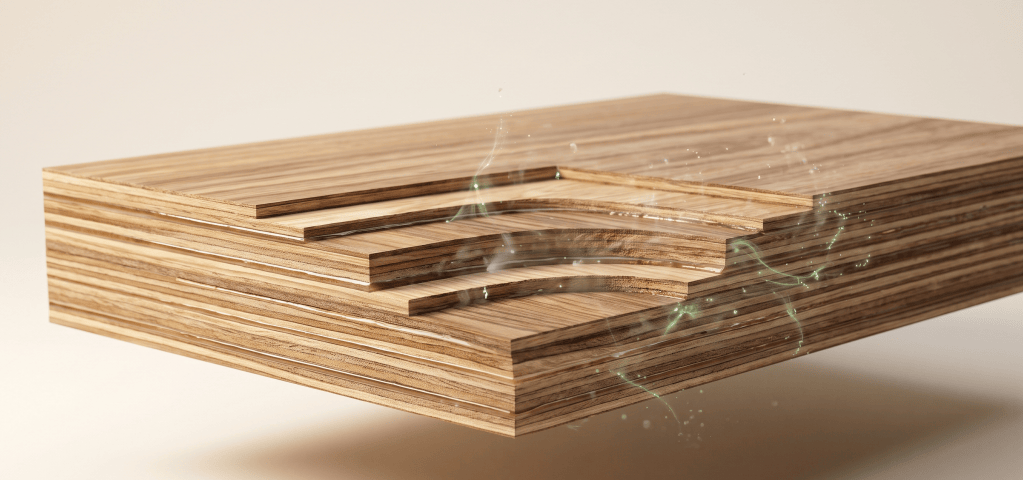
These adhesives help manufacturers produce strong, durable plywood sheets. However, depending on their chemical composition and manufacturing process, they may release formaldehyde even after the plywood has been installed in furniture.
The amount released varies between products. This is why two plywood sheets with similar thickness, appearance, and water resistance may have different formaldehyde emission levels.
How Plywood Adhesives Release Formaldehyde
Plywood is manufactured by arranging thin wood veneers in layers and bonding them under heat and pressure. The adhesive used between these layers influences the plywood’s strength, moisture resistance, and potential formaldehyde emissions.
Common adhesive systems include:
- Urea-formaldehyde (UF) resins: Commonly used in interior-grade engineered wood products. These adhesives can release formaldehyde, particularly when exposed to increased moisture or heat.
- Phenol-formaldehyde (PF) resins: Frequently used in moisture-resistant and exterior-grade plywood. Once properly cured, these adhesives generally produce lower formaldehyde emissions than conventional UF resins.
- Melamine-formaldehyde (MF) and melamine-urea-formaldehyde (MUF) resins: Used in certain plywood products to improve bonding and moisture resistance. Their emission performance depends on the specific formulation and manufacturing conditions.
Some manufacturers also use adhesives without added formaldehyde, such as certain polyurethane-based systems, to produce low-emission plywood.
Why Formaldehyde Emissions Continue After Manufacturing
Formaldehyde emissions do not necessarily stop when plywood leaves the factory. Small amounts of the gas may continue escaping from the adhesive bonds over time through a process called off-gassing.
Several factors can affect how quickly formaldehyde is released:
- Temperature: Higher temperatures can increase the rate of formaldehyde release.
- Humidity: Moisture can contribute to chemical reactions in certain adhesives, increasing emissions.
- Age of plywood: Emissions are often higher when a product is new and generally decrease over time.
- Exposed surfaces and edges: Unsealed plywood surfaces and edges may allow formaldehyde to escape more readily.
For example, a newly installed plywood wardrobe in a poorly ventilated bedroom may contribute more to indoor formaldehyde concentrations than a similar wardrobe in a well-ventilated room.
This makes the choice of plywood adhesive and verified emission rating particularly important for furniture used in enclosed indoor spaces.
What Are the Health Effects of Formaldehyde in Plywood?
Formaldehyde exposure can affect your health, particularly when the gas accumulates in poorly ventilated indoor spaces. Since plywood is commonly used in wardrobes, beds, cabinets, and other furniture, formaldehyde released from adhesives may contribute to the concentration of this chemical in indoor air.
However, the presence of formaldehyde in plywood does not automatically mean the furniture is unsafe. Health risks depend on the amount of formaldehyde present in the air, how long someone is exposed, and their individual sensitivity.
1. Short-Term Effects of Formaldehyde Exposure
Exposure to elevated levels of airborne formaldehyde can cause irritation and discomfort, particularly in enclosed spaces.
Common symptoms include:
- Eye irritation: Burning, redness, or watery eyes.
- Nose and throat irritation: A burning sensation, sore throat, or nasal discomfort.
- Respiratory problems: Coughing, wheezing, or breathing difficulties, especially in people with asthma.
- Skin reactions: Formaldehyde can cause allergic skin reactions in some individuals, particularly through direct contact with formaldehyde-containing materials.
These symptoms are not unique to formaldehyde exposure. Other indoor pollutants, dust, and cleaning chemicals can cause similar reactions.
2. Long-Term Health Risks of Formaldehyde Exposure
Long-term exposure to formaldehyde is a more serious concern, particularly at elevated concentrations.
Formaldehyde is classified as a human carcinogen by the International Agency for Research on Cancer (IARC). Research has established associations between certain occupational exposures and cancers, including nasopharyngeal cancer and leukemia.
However, these findings should not be interpreted to mean that ordinary household plywood use causes cancer. The risks associated with a particular plywood product depend on its actual emissions and the resulting exposure levels.
Repeated exposure may also contribute to persistent irritation and respiratory symptoms in susceptible individuals.
Why Indoor Air Quality Matters for Children and Families
Bedrooms, children’s rooms, and other frequently occupied spaces deserve particular attention because people may spend several hours in them every day.
Children and people with asthma or existing respiratory conditions may experience discomfort from indoor air pollutants. However, scientific evidence has not established that children are necessarily affected by formaldehyde at lower concentrations than adults.
For homeowners, the practical approach is to select plywood with verified low emissions, maintain adequate ventilation, and avoid unnecessary exposure to indoor pollutants.
What Is the Safe Level of Formaldehyde Emission in Plywood?
There is no single formaldehyde emission limit that applies to every type of plywood worldwide. Different countries and certification systems use different testing methods and emission classifications.
The World Health Organization (WHO) recommends that formaldehyde concentrations in indoor air should not exceed 0.1 mg/m³ (approximately 0.08 ppm) over any 30-minute period. This guideline is intended to protect occupants from adverse health effects associated with airborne formaldehyde.
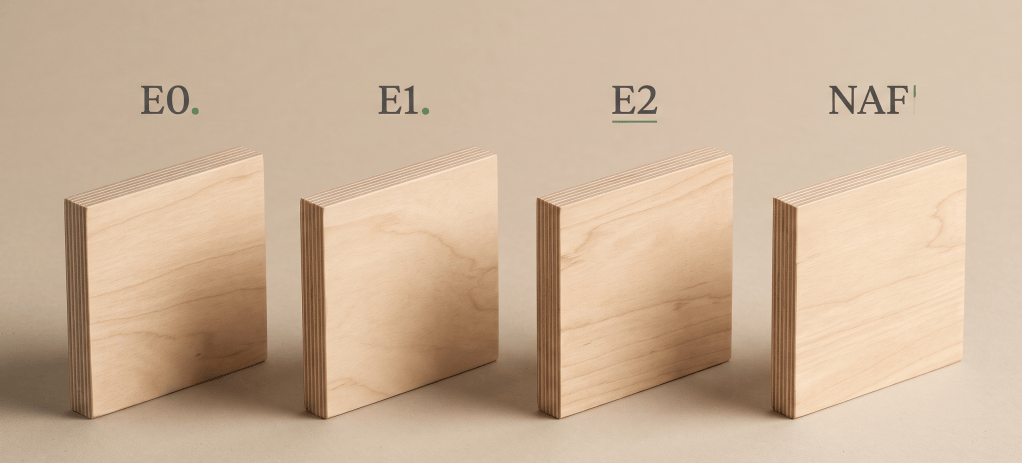
However, this is an indoor air quality guideline, not a plywood manufacturing standard. Plywood emission ratings are determined through laboratory tests that measure formaldehyde released under specified conditions.
How Formaldehyde Emission Levels Are Measured
Manufacturers and testing laboratories use different methods to measure formaldehyde emissions from plywood.
- Chamber method: A plywood sample is placed inside a controlled testing chamber. The concentration of formaldehyde released into the air is measured under specified temperature, humidity, and ventilation conditions.
- Desiccator method: A plywood sample is kept inside a sealed container, and the formaldehyde released is absorbed into water for laboratory analysis.
- Gas analysis method: Air passes over a plywood sample under controlled conditions, allowing laboratories to measure the rate of formaldehyde release.
Test results may be expressed in milligrams per cubic meter (mg/m³), parts per million (ppm), milligrams per liter (mg/L), or milligrams per square meter per hour (mg/m²·h), depending on the method.
These measurements cannot always be compared directly. When checking a plywood test report, verify both the emission value and the testing standard used.
What E0, E1, and E2 Ratings Mean
E0, E1, and E2 are terms commonly encountered when comparing plywood based on formaldehyde emissions. However, their definitions and permissible limits depend on the standard being followed.
| Rating | Formaldehyde emission classification | What it means for buyers |
| E0 | Low-emission designation used in certain standards and product markets. | Look for the applicable standard and laboratory test report. |
| E1 | Lower-emission class under European EN 13986. | Meets the E1 emission requirements under the specified testing method. |
| E2 | Higher-emission class under European EN 13986. | Permits greater emissions than E1 and is less desirable when choosing lower-emission indoor materials. |
| Zero emission | A product claim rather than a universal emission classification. | Verify whether the claim means no added formaldehyde or emissions below a stated detection limit. |
Under the European EN 13986 framework, the E1 classification has traditionally required formaldehyde emissions of no more than 0.124 mg/m³ (approximately 0.1 ppm) when measured using the EN 717-1 chamber method. E2 represents emissions above the relevant E1 classification limit.
E0, however, is not a standard classification under EN 13986. Products advertised as E0 may follow other standards or manufacturer-defined specifications.
For example, two plywood manufacturers may advertise their products as E0, but that does not necessarily mean both have identical formaldehyde emission levels.
For buyers, the actual laboratory test result is more useful than the emission label alone. Ask the manufacturer or plywood dealer for the relevant test report and confirm which standard the product meets before purchasing.
Formaldehyde Emission Standards for Plywood in India
In India, plywood quality and formaldehyde requirements are governed by standards published by the Bureau of Indian Standards (BIS). These standards specify requirements for plywood construction, strength, moisture resistance, testing, and formaldehyde classification.
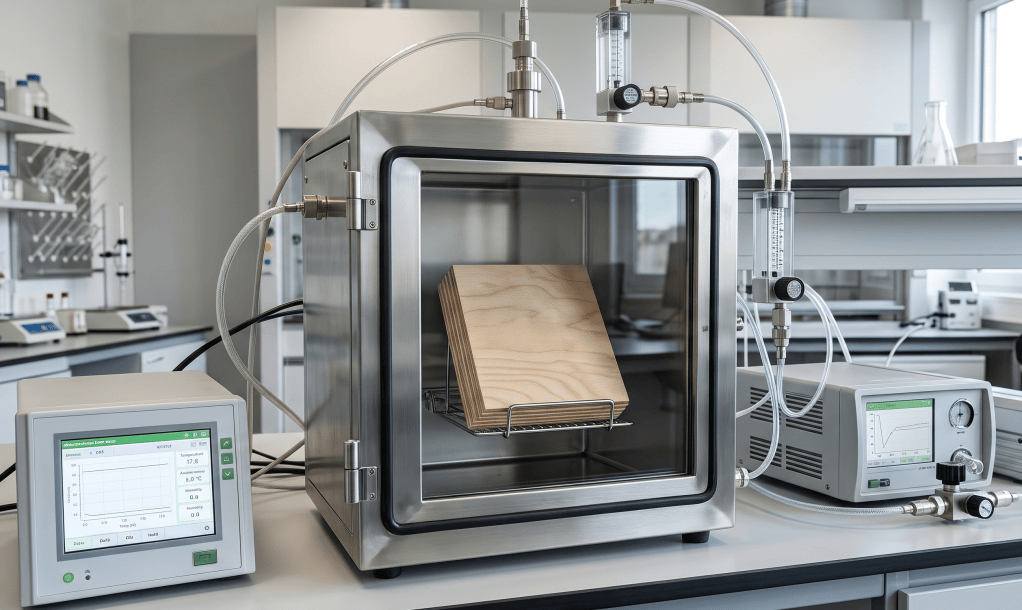
International certification systems also provide formaldehyde emission benchmarks. However, a plywood sheet meeting a water-resistance standard does not automatically have the lowest formaldehyde emissions. Buyers should check both its plywood grade and emission classification.
1. BIS Standards for Plywood
Two important Indian standards are IS 303:2024 and IS 710:2024.
i) IS 303:2024 for General-Purpose Plywood
This standard covers plywood used for furniture, cabinets, partitions, panelling, and other general-purpose applications. It includes three water-resistance grades: MR (Moisture Resistant), BWR (Boiling Water Resistant), and BWP (Boiling Water Proof).
The 2024 revision also includes formaldehyde classifications E1 and E2, along with requirements for formaldehyde testing. A steady-state formaldehyde emission test is listed as an optional requirement.
Consequently, two plywood sheets classified as BWR may have different formaldehyde ratings. The BWR designation describes water resistance, while E1 and E2 describe formaldehyde performance under the applicable standard.
ii) IS 710:2024 for Marine Plywood
IS 710 covers plywood manufactured for demanding moisture conditions, including marine applications. It specifies requirements for bonding, water resistance, strength, durability, and formaldehyde testing.
Like IS 303:2024, the revised marine plywood standard includes E1 and E2 formaldehyde classifications. It also provides for an optional steady-state emission test.
This means marine-grade plywood should not automatically be considered formaldehyde-free or lower-emission simply because it is designed to withstand prolonged moisture exposure.
When purchasing plywood, check the applicable IS number, the manufacturer’s BIS licence details, and the declared formaldehyde class.
International Standards and Certifications
Apart from BIS standards, several international frameworks regulate formaldehyde emissions from engineered wood products. These standards are particularly useful when comparing imported plywood or products advertised with international certifications.
| Standard | Region | Formaldehyde requirements |
| CARB Phase 2 | California, USA | Maximum 0.05 ppm for covered hardwood plywood. |
| EPA TSCA Title VI | USA | Maximum 0.05 ppm for covered hardwood plywood. |
| EN 13986 / E1 | Europe | E1 classification uses a chamber-test limit of 0.124 mg/m³ under EN 717-1. |
| JAS F☆☆☆☆ | Japan | High-performance emission classification with an average desiccator-test limit of 0.3 mg/L. |
CARB Phase 2 and EPA TSCA Title VI impose equivalent emission limits for the covered hardwood plywood category. However, these regulations do not cover every kind of structural or marine plywood.
Japan’s F☆☆☆☆ classification is also associated with low formaldehyde emissions, but its test method differs from the European and American systems.
For Indian homeowners, international certifications can provide additional information about a product’s emission performance. However, they should not replace verification of the applicable Indian standard.
Before purchasing, ask for the manufacturer’s product specifications and formaldehyde test results. A documented emission classification is more reliable than an unsupported claim that the plywood is completely safe or chemical-free.
Which Plywood Has the Lowest Formaldehyde Emission?
Plywood manufactured using low-emission adhesives generally releases less formaldehyde than products made with conventional high-emission adhesive systems. However, the actual emission level depends on the adhesive formulation, manufacturing process, and testing standard.
In India, you may encounter products marketed as E0, E1, zero-emission, no-added-formaldehyde, or low-VOC plywood. Although these terms are often used interchangeably in product descriptions, they do not mean the same thing.
The best way to identify low-formaldehyde plywood is to compare verified laboratory test results rather than relying on product labels alone.
1. E0 Plywood
E0 plywood is marketed as a low-formaldehyde option for indoor furniture and interior applications. It is commonly considered by homeowners looking for materials with reduced emissions for bedrooms, wardrobes, kitchen cabinets, and children’s furniture.
However, E0 does not have one universally accepted definition. Different manufacturers and markets may use the designation according to different specifications.
When comparing E0 plywood, check the testing standard, measured emission value, and supporting certification. A product labelled E0 should not automatically be considered completely formaldehyde-free.
E0 plywood may also cost more than conventional alternatives, depending on the adhesive technology, manufacturer, and product specifications.
2. E1 Plywood
E1 plywood meets a defined formaldehyde emission classification under the applicable standard. It is commonly used as a reference point when selecting engineered wood products for indoor applications.
In India, the E1 classification is included in the revised IS 303:2024 and IS 710:2024 plywood standards.
E1-rated plywood can be considered for wardrobes, cabinets, beds, and other indoor furniture when its emission performance and suitability for the intended application have been verified.
However, E1 does not mean zero formaldehyde emissions. It indicates that the product meets the limits specified by the relevant classification and testing method.
3. No-Added-Formaldehyde Plywood
No-added-formaldehyde (NAF) plywood is manufactured using adhesives that do not contain intentionally added formaldehyde. Certain polyurethane-based adhesives, including polymeric MDI (pMDI), are examples of adhesive systems that can be used for this purpose.
Unlike conventional formaldehyde-based resins, these adhesives do not rely on formaldehyde for bonding wood veneers.
However, no-added-formaldehyde does not necessarily mean zero formaldehyde emissions. Wood naturally contains small amounts of formaldehyde, and measurable emissions may still occur.
The US Environmental Protection Agency (EPA) has specific testing and certification provisions for composite wood products manufactured with no-added-formaldehyde-based resins.
When purchasing plywood advertised as formaldehyde-free or zero-emission, ask the manufacturer to clarify whether the claim refers to the adhesive formulation or actual laboratory emission results.
4. Low-VOC Plywood
Low-VOC plywood is designed or marketed to release lower amounts of volatile organic compounds (VOCs) into the surrounding air.
Formaldehyde is one type of VOC, but plywood and its associated finishes may release other compounds as well. These can originate from adhesives, coatings, surface treatments, and the wood itself.
This creates an important distinction:
- Low-formaldehyde plywood specifically addresses formaldehyde emissions.
- Low-VOC plywood addresses a broader group of volatile organic compounds.
- No-added-formaldehyde plywood describes the adhesive formulation rather than guaranteeing a particular emission level.
A low-VOC label alone does not confirm that a product meets a particular formaldehyde emission standard.
For indoor furniture, compare products using verified formaldehyde test reports alongside their other material specifications. This helps you choose plywood that meets your requirements for both indoor air quality and furniture performance.
How to Choose Low-Formaldehyde Plywood for Your Home
When buying plywood for furniture, water resistance, thickness, and price are usually the first specifications you compare. However, if indoor air quality is a priority, you should also examine the plywood’s formaldehyde emission rating and supporting test reports.
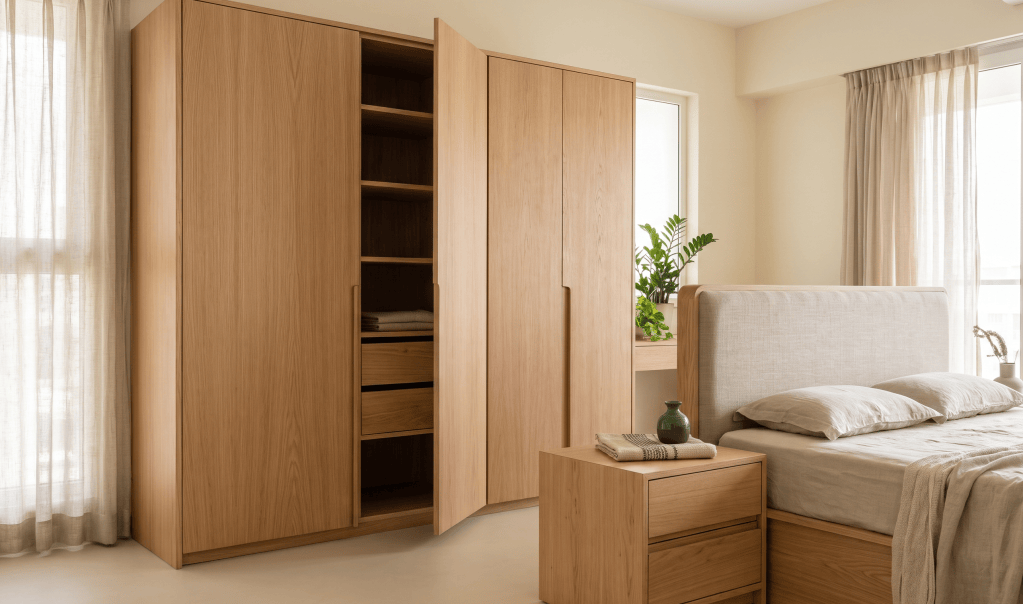
A plywood sheet advertised as E0, E1, or low-VOC is not necessarily the best choice unless the manufacturer can provide evidence supporting the claim.
Here are four factors to consider before purchasing low-formaldehyde plywood.
Step 1: Check the Manufacturer’s Emission Test Report
A formaldehyde emission test report provides measurable information about how much formaldehyde a plywood product releases under controlled laboratory conditions.
Before purchasing, ask the manufacturer or dealer for the following details:
- Emission classification: Confirm whether the plywood is classified as E1, E0, or another emission category.
- Testing standard: Identify the method used to measure formaldehyde emissions, such as a chamber or desiccator test.
- Measured emission value: Check the actual laboratory result rather than relying exclusively on the classification.
- Testing laboratory: Look for reports issued by recognised laboratories, preferably those accredited for the relevant testing method.
- Product identification and report date: Confirm that the test report applies to the plywood product you intend to purchase.
A test report for one product range does not automatically establish the emission performance of every plywood sheet sold under the same brand.
Step 2: Verify Certifications and Product Labels
Plywood packaging and manufacturer documentation can provide information about the product’s quality and compliance with applicable standards.
In India, look for the relevant BIS standard, such as IS 303 for general-purpose plywood or IS 710 for marine plywood.
When a product carries the BIS Standard Mark, verify the associated licence number and confirm that the certification covers the product being purchased.
For plywood marketed as E0, E1, CARB-compliant, or no-added-formaldehyde, ask for documentation supporting that specific claim.
Remember that BWR, BWP, and marine grades describe plywood performance in moisture-related conditions. They do not, by themselves, establish its formaldehyde emission rating.
Step 3: Choose Plywood Based on Furniture Application
Different furniture applications require different combinations of moisture resistance, durability, and emission performance.
| Furniture application | What to consider |
| Bedroom wardrobes | Verified low emissions, suitable thickness, and dimensional stability. |
| Beds and storage units | Low-emission plywood with adequate strength and load-bearing capacity. |
| Children’s furniture | Documented low emissions, smooth finishes, and suitable edge sealing. |
| Kitchen cabinets | Low emissions combined with appropriate moisture resistance, such as BWR or BWP grade where required. |
| Bathroom cabinets | Suitable moisture resistance, low emissions, and protection against water entering through exposed edges. |
| Office furniture | Verified emission ratings, durability, and suitability for frequent indoor use. |
For example, when constructing kitchen cabinets, choosing E1-rated plywood alone is not enough. You must also check whether the sheet has appropriate moisture resistance for the installation.
Similarly, marine plywood may provide excellent water resistance, but its marine designation does not guarantee the lowest formaldehyde emissions.
How Can You Reduce Formaldehyde Emissions from Existing Plywood?
If your furniture is already installed, replacing every plywood cabinet, wardrobe, or bed may not be necessary. You can take several steps to reduce formaldehyde exposure and improve indoor air quality.
Although formaldehyde emissions generally decrease as plywood ages, the rate depends on the adhesive, temperature, humidity, and ventilation. The following measures can help reduce formaldehyde concentrations inside your home.
1. Improve Ventilation
Proper ventilation helps remove formaldehyde released from plywood and other indoor materials. Without adequate airflow, the gas can accumulate, particularly in enclosed bedrooms, storage spaces, and newly furnished rooms.
To improve ventilation:
- Open windows and doors when outdoor air quality and weather conditions permit.
- Use exhaust fans to help remove indoor air pollutants.
- Maintain airflow in rooms containing newly installed plywood furniture.
- Open wardrobe and cabinet doors periodically, especially when the furniture is new.
Ventilation dilutes airborne formaldehyde rather than stopping its release from plywood. However, it can help lower indoor concentrations when fresh air is continuously introduced.
2. Control Indoor Temperature and Humidity
Higher temperatures and humidity levels can increase formaldehyde emissions from certain plywood adhesives.
For example, a closed room exposed to direct sunlight may experience greater formaldehyde release from furniture than a cooler, well-ventilated room.
You can manage these conditions by:
- Maintaining a comfortable indoor temperature and avoiding excessive heat.
- Using exhaust fans in kitchens and bathrooms to remove excess moisture.
- Repairing water leaks and preventing dampness around plywood furniture.
- Using a dehumidifier when indoor humidity remains consistently high.
Keeping indoor relative humidity around 30% to 50%, where practical, can help manage moisture and reduce conditions that encourage emissions.
3. Seal Exposed Plywood Surfaces and Edges
Unfinished plywood surfaces and exposed edges can provide pathways for formaldehyde to escape.
Applying suitable surface finishes may reduce emissions by creating a barrier between the plywood and surrounding air.
Common finishing options include:
- Laminates: Cover plywood surfaces and can act as a barrier when properly bonded.
- Veneers with suitable finishes: Provide a decorative surface while offering some protection when sealed appropriately.
- Low-VOC paints and sealants: Can help seal exposed surfaces without introducing unnecessarily high levels of additional VOCs.
- Edge banding: Covers exposed plywood edges on cabinets, wardrobes, and shelves.
However, finishing does not guarantee complete elimination of formaldehyde emissions. The effectiveness depends on the coating material, application quality, and coverage. Some adhesives and finishes can also release VOCs during application and curing.
4. Consider Air Purifiers with Suitable Gas-Phase Filters
Air purifiers can help manage certain indoor pollutants, but not every filtration system removes formaldehyde.
Standard HEPA filters are designed to capture airborne particles such as dust and pollen. They do not remove formaldehyde gas.
Some air purifiers use activated carbon or other gas-phase filtration media that can capture certain gaseous pollutants, including formaldehyde. However, their effectiveness depends on the filter design, amount of adsorbent material, airflow, and replacement schedule.
If you are considering an air purifier, check whether the manufacturer provides independent testing data for formaldehyde removal.
Ventilation, moisture control, and appropriate surface finishing should remain the primary measures for managing emissions from existing plywood furniture. An air purifier may provide additional assistance, but it cannot replace source control or adequate fresh-air circulation.
Choose Digna Ply for Your Plywood Requirements
Choosing the right plywood involves more than comparing thickness, strength, and water resistance. The adhesives used during manufacturing, formaldehyde emission ratings, and product certifications also deserve attention, particularly when purchasing plywood for indoor furniture.
At Digna Ply, we help you compare plywood options based on your furniture requirements, budget, and preferred specifications. Whether you’re planning kitchen cabinets, bedroom wardrobes, beds, or office furniture, you can discuss the appropriate plywood grade, thickness, moisture resistance, and available emission information before making a purchase.
We also recommend checking manufacturer documentation and formaldehyde test reports when selecting low-emission plywood, rather than relying on E0, E1, or zero-emission labels alone.
Visit Digna Ply or contact us on WhatsApp to discuss your plywood requirements, compare available options, and request a quotation for your next furniture project.
Frequently Asked Questions
Does all plywood contain formaldehyde?
Wood naturally contains small amounts of formaldehyde. Additionally, many plywood manufacturers use formaldehyde-based adhesives to bond wood veneers. However, some plywood products use no-added-formaldehyde adhesives, which can reduce emissions. The actual emission level depends on the adhesive formulation, manufacturing process, and product specifications.
Is E0 plywood completely formaldehyde-free?
No. E0 plywood is generally marketed as a low-formaldehyde product, but it does not guarantee zero emissions. The E0 designation also varies between standards and manufacturers. Check the applicable testing standard and laboratory results to determine the actual formaldehyde emission level.
How long does plywood release formaldehyde?
Plywood may release formaldehyde for months or even years after manufacturing. Emissions are generally higher when plywood is new and tend to decrease over time. However, temperature, humidity, adhesive composition, and surface finishing can affect both the rate and duration of emissions.
Does marine plywood emit formaldehyde?
Yes, marine plywood can emit formaldehyde if it contains formaldehyde-based adhesives. Although marine plywood is manufactured for demanding moisture conditions, its water resistance does not guarantee low formaldehyde emissions. Check the manufacturer’s formaldehyde classification and test reports before purchasing.
Is plywood safer than MDF or particleboard?
Plywood may release less formaldehyde than some conventional MDF or particleboard products, but this is not always the case. Emission levels depend on the adhesive system, manufacturing process, and applicable standards. Low-emission MDF or particleboard may outperform plywood with higher emissions. Comparing verified laboratory results is the most reliable approach.
Can laminating plywood reduce formaldehyde emissions?
Laminating plywood can reduce formaldehyde emissions by creating a barrier over its surfaces. However, the effectiveness depends on the laminate, bonding adhesive, edge sealing, and application quality. Lamination does not guarantee complete elimination of emissions, and some finishing adhesives may release additional VOCs.
Is low-formaldehyde plywood more expensive in India?
Low-formaldehyde plywood can cost more than conventional alternatives because of adhesive technology, manufacturing processes, and testing requirements. However, prices also depend on plywood thickness, wood species, core quality, water-resistance grade, and brand. Compare products with similar specifications and verified emission ratings before deciding.


Leave a Reply