Plywood used at a construction site are used for different purposes. Some sheets are used temporarily to create moulds for concrete slabs, beams, columns, and walls, while others become part of the finished building through doors, partitions, furniture, or interior work.
This is why shuttering plywood and normal construction plywood should not be treated as interchangeable materials. Shuttering plywood is designed primarily for concrete formwork. It has a dense core and is commonly supplied with a film-faced surface that helps it handle wet concrete and repeated use. Other construction plywood types, including MR, BWR, and BWP plywood, are made for different applications where factors such as moisture resistance, finishing, and long-term use matter more.
In this article, we’ll compare shuttering vs. construction plywood based on their uses, surface, thickness, water resistance, reuse cycles, and price factors. We’ll also look at film-faced shuttering plywood, common sizes available in India, and how to choose the right plywood for your construction requirement.
What Is Shuttering Plywood?
Shuttering plywood is a type of plywood made for concrete formwork. During construction, it is used to create temporary moulds that hold wet concrete in the required shape until it sets and gains enough strength. Builders commonly use it for slabs, beams, columns, walls, foundations, and other reinforced concrete structures.
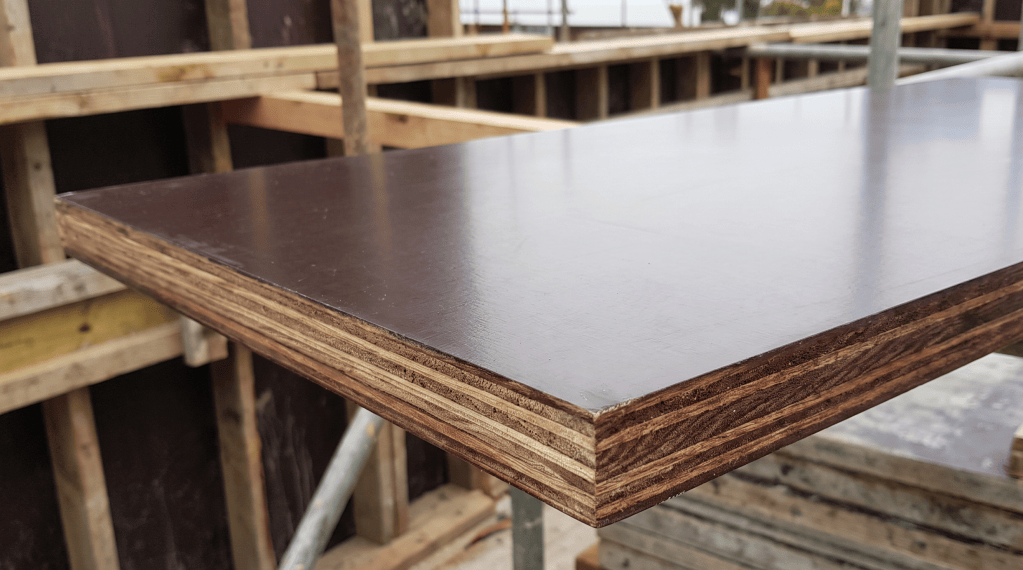
Compared with normal plywood, shuttering plywood is generally denser and built to handle moisture, pressure, repeated handling, and contact with wet concrete. Many shuttering boards also have a smooth coated surface that makes de-shuttering easier and helps reduce concrete sticking to the sheet.
Here are common uses of shuttering plywood:
- It is used below concrete slabs to create a flat supporting surface during casting.
- It is used around columns and beams to hold concrete in the required shape.
- It is used for concrete walls and foundations where temporary formwork is needed.
- It can be reused across multiple casting cycles when the board is handled and maintained properly.
Film faced shuttering plywood has a smooth phenolic film applied to its outer surfaces. This coating helps reduce water absorption from wet concrete and protects the face of the plywood during repeated use. The smooth surface can also produce a cleaner concrete finish and makes it easier to remove and clean the board after casting.
In the Indian market, shuttering plywood is also commonly differentiated by board weight, with options such as 30 kg, 34 kg, and 38 kg per sheet mentioned in the supplied brief. Weight can indicate differences in density and construction, but it should not be used as the only factor when comparing boards. Core quality, bonding, film quality, thickness, and expected reuse should also be considered.
The most common shuttering plywood sheet size in India is 8 ft × 4 ft, or approximately 2440 mm × 1220 mm. This standard size makes it easier for contractors to plan formwork layouts, estimate sheet requirements, and reduce unnecessary cutting at the site.
Thickness can vary depending on the type of formwork and expected load. Common options include 12 mm, 15 mm, 18 mm, and 21 mm, which we will compare later in this guide.
What Is Construction Plywood?
Construction plywood is a broad term used for plywood and related boards used during building, renovation, interior, and carpentry work. Unlike shuttering plywood, which has a clearly defined role in concrete formwork, construction plywood can refer to different grades selected according to where and how the board will be used.
Common construction plywood types include:
- MR plywood is generally used for dry interior applications such as furniture, shelves, partitions, and other areas with limited moisture exposure.
- BWR plywood is better suited to areas where the board may occasionally come into contact with moisture.
- BWP plywood is selected for applications that require much higher resistance to water, such as kitchens and other moisture-prone areas.
- Shuttering plywood is used specifically for concrete formwork, including slabs, beams, columns, and walls.
- Blockboard may also be used in selected construction and interior applications, particularly where longer panels and dimensional stability are required.
The main point is that there is no single construction plywood that works best everywhere. The right choice depends on the job. A board used for a wardrobe has different requirements from one used below a concrete slab, while plywood used in a kitchen needs different moisture resistance from plywood used in a dry partition.
The supplied brief groups MR, BWR, BWP, shuttering plywood, and blockboards among the common construction plywood types discussed in the Indian market.
Shuttering Plywood vs Normal Plywood
Shuttering plywood and normal plywood are made for very different jobs. Shuttering plywood is designed for temporary concrete formwork, where the board must handle wet concrete, pressure, moisture, repeated handling, and multiple casting cycles. Normal plywood, including MR, BWR, and BWP grades, is generally selected for furniture, partitions, cabinets, doors, and other interior applications.
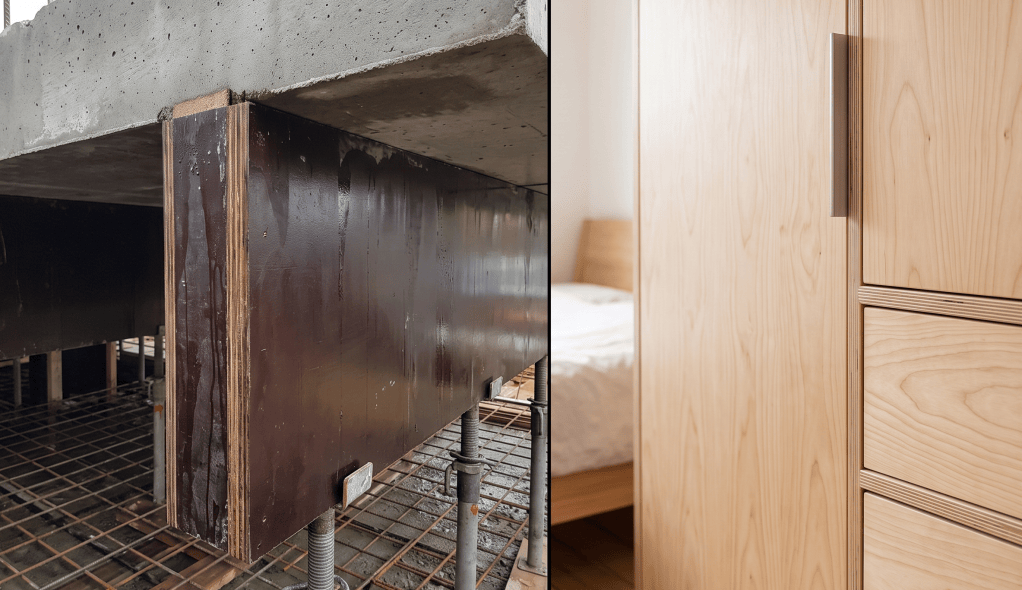
The biggest difference is not simply strength. It is the way each board is built, finished, and expected to perform during use.
| Feature | Shuttering Plywood | Normal Plywood |
| Primary use | Concrete formwork for slabs, beams, columns, and walls | Furniture, cabinets, partitions, doors, and interior work |
| Surface finish | Commonly film faced with a smooth coated surface | Usually supplied with a natural veneer surface |
| Moisture handling | Built to handle repeated contact with wet concrete | Depends on whether the plywood is MR, BWR, or BWP grade |
| Bonding | Commonly uses phenolic resin bonding for demanding site conditions | Bonding system varies according to plywood grade |
| Reusability | Designed for repeated formwork cycles | Not normally purchased for repeated concrete casting |
| Density and weight | Usually denser and heavier | Varies widely by grade, core, and application |
| Finishing | Surface is intended for concrete release rather than decorative finishing | Better suited to laminates, veneers, paint, and furniture finishes |
| Typical buyer | Builders, contractors, and civil construction teams | Homeowners, carpenters, interior contractors, and furniture makers |
Choose shuttering plywood when the board will be used to hold concrete during casting. Choose normal MR, BWR, or BWP plywood when the plywood will remain part of the finished building, such as in furniture, cabinetry, partitions, or interior woodwork.
Using normal plywood for concrete shuttering can shorten the usable life of the sheet, while using film-faced shuttering plywood for finished furniture can make surface finishing and carpentry more difficult.
Marine Plywood vs Shuttering Plywood
Marine plywood and shuttering plywood are both made to perform in wet conditions, but they are intended for different applications. Marine plywood is designed for long-term use in areas with high moisture exposure, while shuttering plywood is made mainly for temporary concrete formwork.
The supplied brief identifies IS 710 for marine plywood and IS 4990 for shuttering plywood. It also notes that shuttering plywood commonly uses phenolic bonding and a coated surface so it can handle wet concrete and repeated casting cycles.
Here is the basic difference between Marine plywood and Shuttering plywood:
- Marine plywood is suited to applications where the board remains in place and continues to face moisture over time.
- Shuttering plywood is suited to temporary concrete moulds for slabs, beams, columns, and walls.
- Marine plywood is generally selected where long-term durability and finishing matter.
- Shuttering plywood is selected where repeated use, concrete release, and resistance to site conditions matter more than appearance.
- Using marine plywood for temporary shuttering can increase material cost unnecessarily.
- Using shuttering plywood for finished interior work may create problems with decorative finishing and surface treatment.
For concrete casting and formwork, shuttering plywood is the more suitable option because it is made for repeated contact with wet concrete and site handling.
For permanent high-moisture applications, marine plywood is usually the better fit because it is intended to remain part of the finished structure or furniture rather than act as temporary formwork.
How Many Times Can Shuttering Plywood Be Reused?
Shuttering plywood may be reused from around 5 times to more than 30 times, while premium high-density or plastic-faced boards can sometimes support higher repetition counts.
The actual number of uses can vary widely because shuttering plywood is exposed to wet concrete, pressure, scraping, moisture, and repeated movement between casting cycles. A good-quality board can still lose life quickly if it is damaged during de-shuttering or left exposed to rain and standing water.
Some of the main factors that affect reuse include:
- Core quality: A stronger and more uniform core usually handles repeated loading better.
- Film quality: A good surface film helps protect the face from moisture and concrete sticking.
- De-shuttering method: Rough removal can damage edges and surfaces after only a few uses.
- Cleaning: Concrete residue should be removed soon after each use.
- Shuttering oil: Proper oiling can reduce sticking and make future de-shuttering easier.
- Storage: Sheets should be stacked flat and protected from prolonged exposure to rain and moisture.
Can Shuttering Plywood Be Used for Furniture?
Shuttering plywood is generally not recommended for home furniture because it is designed for concrete formwork rather than interior carpentry. Its surface, weight, bonding system, and finishing requirements are different from plywood made for wardrobes, cabinets, beds, and other furniture.
There are several reasons why it may not be the right choice for furniture:
- The surface is made for formwork, not decorative finishing. Film-faced shuttering plywood can be difficult to finish with laminates, veneers, paint, or polish compared with regular furniture plywood.
- It can be heavier and denser. This may make cutting, handling, and furniture assembly less convenient.
- It is not designed for fine carpentry joints. Shuttering boards are made to withstand construction-site use rather than detailed furniture fabrication.
- The bonding system is intended for demanding site conditions. The supplied brief notes the use of phenolic resins in shuttering plywood and advises against using such boards for enclosed interior furniture applications.
For most furniture applications, it is better to choose plywood according to the expected moisture level. MR plywood can suit dry interiors, while BWR or BWP plywood may be better for furniture exposed to higher humidity or occasional water contact.
How to Choose Between Shuttering and Construction Plywood
The right plywood depends mainly on where it will be used. Shuttering plywood is made for temporary concrete formwork, while other plywood grades are better suited to permanent interior, furniture, and moisture-prone applications.
A simple way to choose is to match the plywood type with the job:
- Choose shuttering plywood for slabs, beams, columns, walls, and other concrete formwork where repeated use and contact with wet concrete are expected.
- Choose MR plywood for dry indoor applications such as basic furniture, shelves, and partitions where moisture exposure is limited.
- Choose BWR plywood for areas where occasional moisture or humidity is expected.
- Choose BWP plywood for kitchens, bathrooms, utility areas, and other applications that need stronger resistance to water.
- Choose marine plywood where the application requires long-term performance in very high-moisture conditions.
Thickness should also be selected according to the job. For shuttering work, factors such as concrete pressure, support spacing, sheet condition, and expected reuse matter as much as thickness. For furniture and interior work, the required thickness depends on the load, span, and type of furniture being built.
Price should be treated as one part of the decision rather than the only factor. A cheaper sheet that needs frequent replacement can cost more over the full project than a better-quality board that lasts through more uses.
Choose Digna Ply for Shuttering and Construction Plywood
At Digna Ply, you can compare shuttering plywood along with MR, BWR, BWP, marine plywood, and other options based on project requirements and budget.
We focus on three things:
- Reliable product quality: We help you compare the grade, thickness, core quality, film quality, and other specifications before purchase.
- Competitive pricing: You can compare multiple plywood options across different price ranges without selecting a lower-grade board for demanding applications.
- Plywood and hardware in one place: You can purchase plywood along with hinges, channels, handles, fittings, and other hardware required for construction and interior work.
If you are buying shuttering plywood for formwork or construction plywood for interiors, call or WhatsApp Digna Ply at 8881306046 to check available sizes, specifications, quantities, and current pricing.
Frequently Asked Questions
What is the main difference between shuttering plywood and normal plywood?
Shuttering plywood is made mainly for concrete formwork, while normal plywood is generally used for furniture, partitions, cabinets, doors, and other permanent applications. Shuttering plywood is usually denser, more resistant to wet site conditions, and often comes with a film-faced surface for easier concrete release.
What is shuttering plywood used for?
Shuttering plywood is used to create temporary moulds for wet concrete. It is commonly used while casting slabs, beams, columns, walls, foundations, and other concrete structures.
Which thickness of plywood is best for shuttering?
Common shuttering plywood thicknesses include 12 mm, 15 mm, 18 mm, and 21 mm. The supplied brief identifies 18 mm as a commonly recommended option for heavier slab casting, but the right thickness also depends on support spacing, concrete pressure, formwork design, and board quality.
How many times can shuttering plywood be reused?
The supplied brief gives a broad range of around 5 to more than 30 uses depending on board quality, film, maintenance, handling, and storage. Reuse should therefore be treated as an expected range rather than a fixed guarantee.
Is film faced plywood waterproof?
Film faced shuttering plywood is designed to resist moisture and repeated contact with wet concrete. The phenolic film helps reduce water absorption, but performance still depends on the quality of the board, edges, bonding, and condition of the surface.
Can shuttering plywood be used for furniture?
It can physically be cut and used, but it is generally not recommended for home furniture. Its surface and construction are designed for formwork rather than decorative finishing, fine carpentry, or permanent interior applications.


Leave a Reply