A bed carries more weight and faces more daily stress than most bedroom furniture. The frame must support the mattress, people sleeping on it, and storage compartments.
Indian homes add specific challenges while choosing the plywood for bed. High humidity can weaken low-grade plywood, especially in coastal cities and rooms with damp walls. Heavy mattresses can cause poorly supported bed panels to sag over time. Termites and wood-boring insects can also damage untreated plywood from within, often before the problem becomes visible.
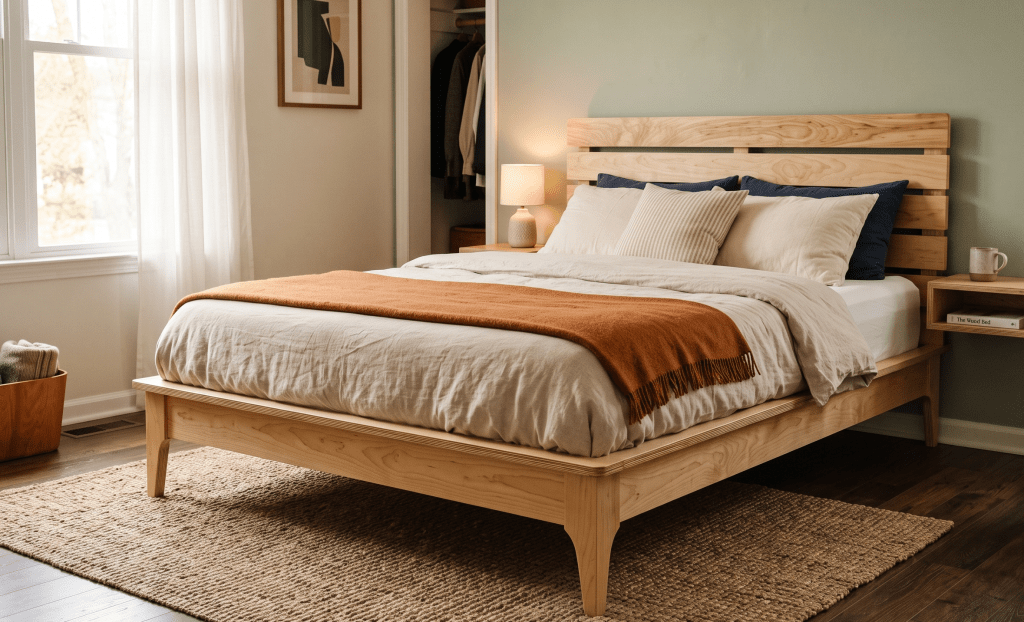
If you choose the lowest-priced plywood, it may reduce the initial cost, but it can lead to loose joints, damaged storage sections, uneven mattress support, or complete replacement of the bed frame.
The right plywood should provide the right balance of strength, moisture resistance, durability, and price:
- Durability: Good-quality plywood can handle daily weight, movement, humidity, and regular use without warping or separating between layers.
- Cost-efficiency: Spending slightly more on the correct plywood grade can reduce future repair, polishing, and replacement expenses.
- Structural integrity: The right grade and thickness help the outer frame, mattress base, storage partitions, and headboard remain stable and properly aligned.
How is a High-Quality Wooden Bed Built?
Different parts handle different levels of weight, movement, and pressure in a bed. The outer frame and mattress support need thicker, denser plywood, while internal storage dividers can use slightly thinner sheets to control the total cost and weight.
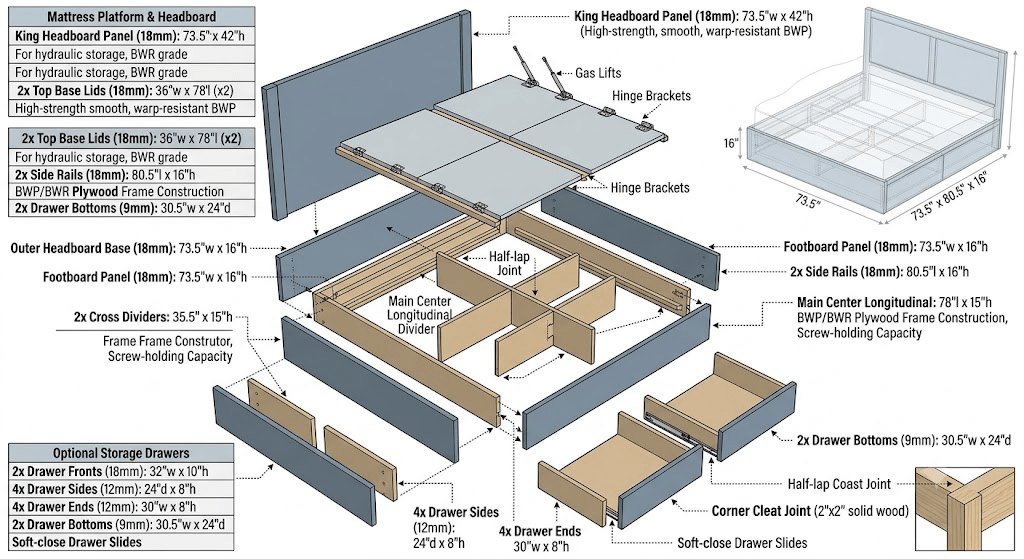
This is how a typical bed is built:-
- Outer frame: The outer frame carries the main load of the bed and keeps the structure properly aligned.
- Mattress base or support slats: The mattress base or support slats distribute the weight of the mattress and the people using the bed.
- Headboard: The headboard provides back support and forms the main visual feature of the bed.
- Hydraulic storage lid: The hydraulic storage lid lifts the mattress platform and provides access to the storage space below.
- Internal box storage dividers: The internal dividers separate the storage sections and support the mattress platform from underneath.
- Storage drawer sides and base: The drawer sides and base hold clothes, bedding, and other items stored inside the bed.
The load-bearing parts should never be made from thin or low-density plywood simply to reduce the budget. The outer frame, central support, hydraulic lid, and mattress base directly affect the strength and service life of the bed.
Non-load-bearing parts, such as decorative headboard panels or lightweight drawer bases, can use thinner plywood. This helps reduce material costs without weakening the main structure.
Which Type of Plywood Is Best for Beds in India: MR, BWR, or BWP?
MR, BWR, and BWP grades differ mainly in the adhesive used between the wood veneers and their ability to withstand moisture and prolonged water exposure.
For most Indian homes, BWR plywood provides a sensible balance between moisture protection and cost. MR plywood may work for a basic bed in a dry room, but it carries a higher risk of swelling or layer separation if the room develops dampness.
BWP plywood costs more but provides added protection in humid cities, ground-floor bedrooms, homes with wall seepage, or beds expected to remain in use for many years.
Here’s how to go about choosing plywood for your bed:-
| Plywood Grade | Moisture Resistance Level | Indicative 18mm or 19mm Price | Suitability for Beds |
| Moisture Resistant | Handles normal indoor humidity but cannot tolerate prolonged water exposure | ₹50 to ₹100 per sq. ft. | Suitable for low-budget beds kept in dry, well-ventilated bedrooms |
| Boiling Water Resistant | Provides better resistance to humidity, occasional spills, and damp conditions | ₹85 to ₹160 per sq. ft. | A practical choice for most bed frames, storage beds, and bedroom furniture |
| Boiling Water Proof | Designed to withstand prolonged exposure to water and high humidity | ₹130 to ₹220 per sq. ft. | Suitable for coastal areas, damp bedrooms, premium beds, and long-term use |
The listed prices are broad market estimates. The final rate depends on the city, brand, wood species, core construction, warranty, certification, and dealer margin. Current 2026 market references show wide price differences even within the same grade.
Recommended Plywood Thickness for Each Part of a Bed
18mm plywood is generally strong enough for a standard double bed when the frame is properly designed and supported. In many Indian markets, carpenters also refer to this size as 19mm plywood because the finished thickness can vary slightly by manufacturer.
The strength of a bed does not depend on plywood thickness alone. It also depends on the plywood grade, core density, number of support members, quality of joints, screw-holding capacity, and how evenly the mattress load is distributed.
For a standard 6×6-foot double bed, 18mm plywood is commonly used for the outer frame, hydraulic storage lid, headboard, and main structural partitions. Thinner plywood may be used for drawers or decorative sections that do not carry the main load.
Each part of the bed handles a different amount of weight, so using the same thickness everywhere may increase cost and make the bed unnecessarily heavy.
| Bed Component | Recommended Thickness | Reason |
| Outer frame | 18mm to 19mm | Provides firm support for joints, screws, and the overall bed structure |
| Mattress base or top lid | 18mm | Supports the mattress and distributes body weight across the frame |
| Support slats | 12mm to 18mm | Works when supported by wooden or metal cross-members at regular intervals |
| Central storage partitions | 18mm | Adds structural support and prevents the mattress base from sagging |
| Storage drawer sides | 12mm | Provides enough strength for regular storage without adding excess weight |
| Drawer base | 6mm to 9mm | Suitable for clothes, bedding, and other lightweight items |
| Headboard | 12mm to 18mm | Depends on whether it is decorative or used for back support |
| Hydraulic storage lid | 18mm | Handles repeated opening, closing, and the weight of the mattress |
Even good-quality 18mm plywood can bend if it spans a large area without enough support underneath.
A double bed should have a central support beam, internal partitions, or cross-members placed at suitable intervals. These supports distribute the load and reduce pressure on the plywood sheet. A large unsupported top panel is more likely to sag, especially under a heavy coir, latex, or spring mattress.
Plywood thicker than 18mm is rarely necessary for a standard residential bed, but it may be considered in a few cases.
- The bed is wider than a standard king-size frame.
- The mattress is unusually heavy.
- The bed is designed for three or more regular users.
- The frame has fewer internal supports.
- The bed includes heavy hydraulic storage hardware.
- The design uses long unsupported plywood panels.
For most Indian homes, 18mm BWR or BWP plywood with proper internal support is strong enough for a double bed. Good frame design and accurate carpentry usually matter more than increasing the plywood thickness beyond 18mm.
How Many Plywood Sheets Are Required for a 6×6 Double Bed?
A typical 6×6-foot double bed with box or hydraulic storage usually requires four to five standard 8×4-foot plywood sheets. The final quantity depends on the bed height, storage design, number of internal partitions, headboard size, cutting plan, and whether the mattress platform uses full plywood panels or support slats.
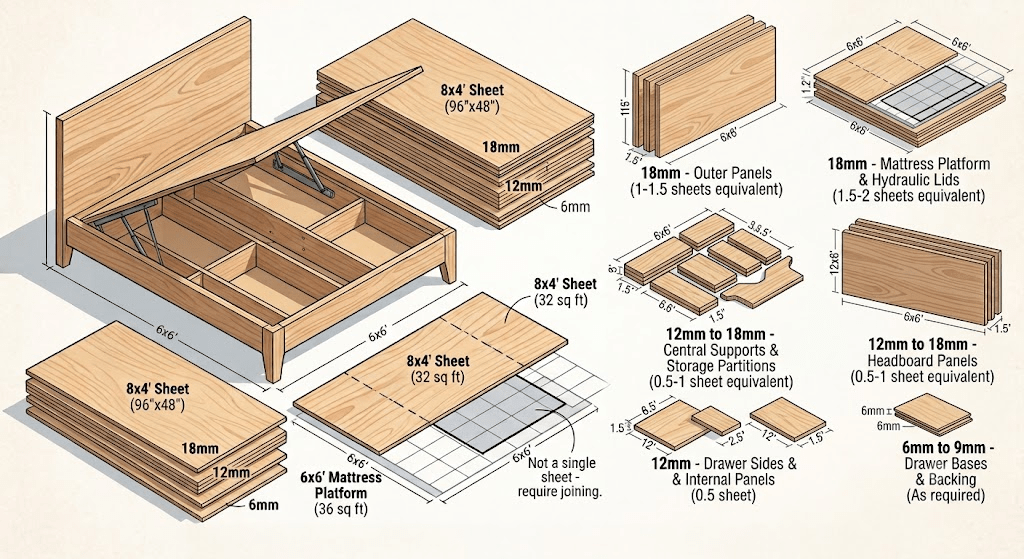
One standard 8×4-foot plywood sheet covers 32 square feet. A 6×6-foot mattress platform alone covers 36 square feet, so it cannot be cut from a single sheet without joining multiple panels.
What Is the Approximate Sheet Requirement for Each Bed Component?
The following calculation provides a practical estimate for a storage bed with an outer frame, internal partitions, top panels, and a medium-sized headboard.
| Bed Component | Approximate Plywood Requirement | Suggested Thickness |
| Outer side panels and end panels | 1 to 1.5 sheets | 18mm |
| Mattress platform or hydraulic lids | 1.5 to 2 sheets | 18mm |
| Central supports and storage partitions | 0.5 to 1 sheet | 12mm to 18mm |
| Headboard | 0.5 to 1 sheet | 12mm to 18mm |
| Drawer sides or small internal panels | 0.5 sheet | 12mm |
| Drawer bases and backing panels | As required | 6mm to 9mm |
A bed with a simple frame and no storage may require fewer sheets. A hydraulic bed with multiple storage compartments, drawers, a tall headboard, or fully enclosed bottom panels may require more.
Do All Five Sheets Need to Be 18mm Thick?
Using 18mm plywood for every section can make the bed heavier and more expensive than necessary. A mixed-thickness plan is usually more efficient.
- Two to three 18mm sheets may be used for the outer frame, mattress platform, hydraulic lids, and main supports.
- One 12mm sheet may be used for storage partitions, drawer sides, and lighter panels.
- One 6mm or 9mm sheet may be used for drawer bottoms, rear covers, or non-load-bearing surfaces.
For a standard 6×6 storage bed, homeowners should budget for four sheets in a basic design and up to five sheets for a hydraulic design with a large headboard. The carpenter should prepare a cutting plan before the sheets are purchased to reduce waste and avoid buying an extra sheet unnecessarily.
Is Waterproof Plywood Worth the Extra Cost for a Bed?
Waterproof plywood for a bed is useful in certain conditions, but it is not necessary for every bedroom. In most dry Indian homes, good-quality BWR plywood is sufficient for the outer frame, storage partitions, and headboard. BWP plywood becomes more practical when the bed is exposed to high humidity, wall dampness, or repeated moisture.
The extra cost should be judged against the room conditions and expected life of the furniture. Paying more for BWP plywood in a dry, well-ventilated bedroom may provide limited additional benefit. Using low-grade plywood in a damp bedroom, however, can lead to swelling, loose joints, veneer separation, and damaged storage sections.
When Should You Choose BWP Plywood for a Bed?
BWP plywood is a better choice when the bed is likely to face moisture for long periods or is expected to remain in use for many years.
- The bedroom is located in a humid coastal city such as Mumbai, Chennai, Kochi, Goa, or Kolkata.
- The bed is placed against a wall that has seepage, condensation, or recurring damp patches.
- The bedroom is on the ground floor, in a basement, or in a poorly ventilated part of the house.
- The bed includes hydraulic storage that holds clothes, blankets, or seasonal items for long periods.
- The homeowner wants a permanent bed with lower risk of moisture-related repairs.
- The property remains closed for long periods, allowing humidity to build up inside the room.
When is BWR Plywood Enough for a Bed?
BWR plywood provides good moisture protection for bedrooms that remain dry and have no history of water seepage.
- The room has regular ventilation and receives adequate sunlight.
- The bed is not placed directly against a damp wall.
- There is no risk of water entering during monsoon months.
- The furniture is intended for normal residential use.
- The budget needs to remain controlled without using basic MR-grade plywood.
- The bed has a well-designed frame with proper internal support.
What Is the Best Choice for Most Indian Homes?
For most homes, BWR plywood offers the right balance of price, strength, and moisture resistance. It is suitable for standard double beds, box storage beds, headboards, and internal partitions when the bedroom remains reasonably dry.
How to Identify Genuine Plywood and Avoid Counterfeits?
Two sheets carrying the same thickness and grade label can differ greatly in core quality, adhesive bonding, veneer construction, and treatment. Checking the sheet before purchase can help you avoid hollow cores, false grade claims, undersized thickness, and products sold with copied certification markings.
1. Check the IS certification mark.
The certification details printed on the sheet should match the plywood grade being sold by the dealer.
- Look for the BIS Standard Mark, commonly called the ISI mark.
- For marine-grade plywood, check for IS 710:2024 on the sheet. The Bureau of Indian Standards currently lists IS 710:2024 as the specification for marine plywood.
- For general-purpose plywood, check whether the sheet carries the applicable IS 303:2024 marking.
- Look for the CM/L licence number printed near the certification mark.
- Verify the CM/L number through the official BIS portal instead of relying only on the printed stamp.
- Make sure the grade, thickness, manufacturer name, and batch details are clearly readable.
An ISI logo alone does not prove that the sheet is genuine because certification details can be copied. Buyers should verify the licence number and purchase from an authorised seller.
2. Check for hollow core gaps
Internal gaps weaken the sheet and reduce its ability to hold screws, nails, and fittings over time.
- Inspect all four edges for visible holes, overlapping veneers, loose layers, or uneven core strips.
- Tap different areas of the sheet with your knuckles. A firm and consistent sound is preferable to isolated hollow sounds.
- Compare the sound near the centre with the sound around the edges.
- Ask the dealer to show a cut sample from the same product range.
- Avoid sheets with open gaps or crumbling material visible along the edges.
The tap test can help identify larger hollow areas, but it cannot detect every internal gap. Edge inspection and a cut sample provide a better assessment when used with the tap test.
3. Check the Thickness and Weight
A sheet sold as 18mm plywood may measure slightly less after sanding, but large differences can indicate poor manufacturing or incorrect labelling.
- Measure the sheet at several points with a vernier calliper or thickness gauge.
- Compare sheets of the same size, grade, and stated thickness.
- A sheet that feels unusually light may contain low-density wood, excessive gaps, or thin core veneers.
- Check that the sheet lies flat and does not show visible bending or twisting.
- Do not select plywood based on weight alone because different wood species naturally have different densities.
Weight is most useful as a comparison between two sheets with the same stated specifications rather than as an independent quality test.
4. Test Screw and Nail Holding
A bed frame depends heavily on screws, brackets, hinges, and hydraulic fittings, so the plywood must hold fasteners firmly.
- Request a small sample or offcut from the dealer.
- Drive a screw near the edge and check whether the layers split.
- Remove and refit the screw to see whether the hole becomes loose immediately.
- Check whether the screw remains firm when moderate sideways pressure is applied.
- Avoid testing directly on a full sheet without the dealer’s permission.
Plywood with a dense, well-bonded core usually provides better holding strength than sheets with gaps or loosely arranged veneers.
Finally, use this checklist before approving plywood for a bed frame.
- Confirm that the plywood grade matches the room conditions.
- Check for the correct IS 303 or IS 710 marking.
- Verify the CM/L licence number.
- Measure the actual sheet thickness.
- Inspect all edges for core gaps.
- Tap several areas to check for inconsistent hollow sounds.
- Compare the weight with another sheet of the same specification.
- Test screw holding on a sample or offcut.
- Scan the manufacturer’s QR code where available.
- Confirm that the dealer is authorised by the brand.
- Request a proper GST invoice mentioning the brand, grade, size, and thickness.
- Save all warranty and verification records.
A suspiciously low price should be treated carefully, especially when a sheet labelled BWP is being sold close to the price of basic MR plywood. Compare written specifications rather than depending on the dealer’s verbal claims.
Choose Digna Ply for Your Bed Plywood
Digna Ply supplies plywood from trusted brands and helps you check the grade, thickness, core quality, and certification before purchase. You can compare options across different price ranges without compromising on the plywood used for load-bearing sections. You can also buy matching bed hardware, including hinges, drawer channels, hydraulic fittings, and handles, from the same place.
Call or WhatsApp 8881306046 for plywood and hardware in Dehradun.
Frequently Asked Questions
Which Plywood Is Best for Bed Frames in India?
BWR plywood is the best choice for most bed frames in India because it provides good moisture resistance at a moderate price. BWP plywood is better for coastal cities, damp bedrooms, ground-floor rooms, and hydraulic storage beds. MR plywood should be limited to dry rooms and lighter, non-load-bearing sections.
What Is the Best Plywood Thickness for a Bed Frame?
Use 18mm or 19mm plywood for the outer frame, mattress platform, main storage partitions, and hydraulic lids. A thickness of 12mm can be used for drawer sides and lighter dividers, while 6mm to 9mm plywood is generally suitable for drawer bottoms and back panels.
Is Local Plywood Suitable for a Bed?
Local plywood may be used when its grade, thickness, core density, and certification can be verified. Avoid relying only on the dealer’s verbal assurance. For load-bearing parts, certified branded BWR or BWP plywood is usually a safer option because product quality and warranty terms are easier to verify.
How Can You Protect a Plywood Bed From Termites and Moisture?
Use termite-treated BWR or BWP plywood, seal all cut edges, and keep the bed away from damp walls. Make sure the room is ventilated and repair wall seepage early. Keep the purchase invoice and warranty details in case the plywood develops a manufacturing defect.
Which Type of Plywood Is Best for a Bed Frame?
BWR plywood is the best option for most bed frames because it provides good strength, moisture resistance, and affordability. BWP plywood is better for humid cities, damp bedrooms, ground-floor rooms, and hydraulic storage beds. Use 18mm or 19mm plywood for the main frame, mattress platform, and load-bearing partitions.
How Does Plywood Compare to MDF or Particle Board for Bed Durability?
Plywood is generally stronger and more durable than MDF or particle board for bed construction. Its cross-layered veneers provide better screw-holding strength, bending resistance, and load-bearing capacity. MDF works well for decorative panels and smooth painted finishes, while particle board is more suitable for low-cost, lightweight furniture. For the outer frame, mattress base, storage partitions, and hydraulic fittings, plywood is the safer material.


Leave a comment