A green building is designed to reduce energy use, manage water better, minimize construction waste, and improve the comfort of people using the space. This can include simple decisions such as better ventilation, natural lighting, low-VOC materials, rainwater harvesting, and energy-efficient fixtures. It can also include advanced choices such as solar power, smart building systems, and net-zero carbon design.
As electricity costs rise and environmental concerns grow, sustainable construction is becoming more relevant for builders, architects, homeowners, and businesses. Standards like LEED, BREEAM, IGBC, GRIHA, and WELL also give developers a measurable way to plan and prove the sustainability of their buildings.
In this guide, we’ll talk about what green building means, its key design elements, its benefits, common certification standards, cost considerations, and the role of better building materials in creating long-lasting sustainable spaces.
What Is Green Building?
Green building is the practice of designing, constructing, and operating buildings in a way that reduces environmental impact and improves long-term performance. It focuses on using energy, water, materials, and space more responsibly without compromising comfort, safety, or function.
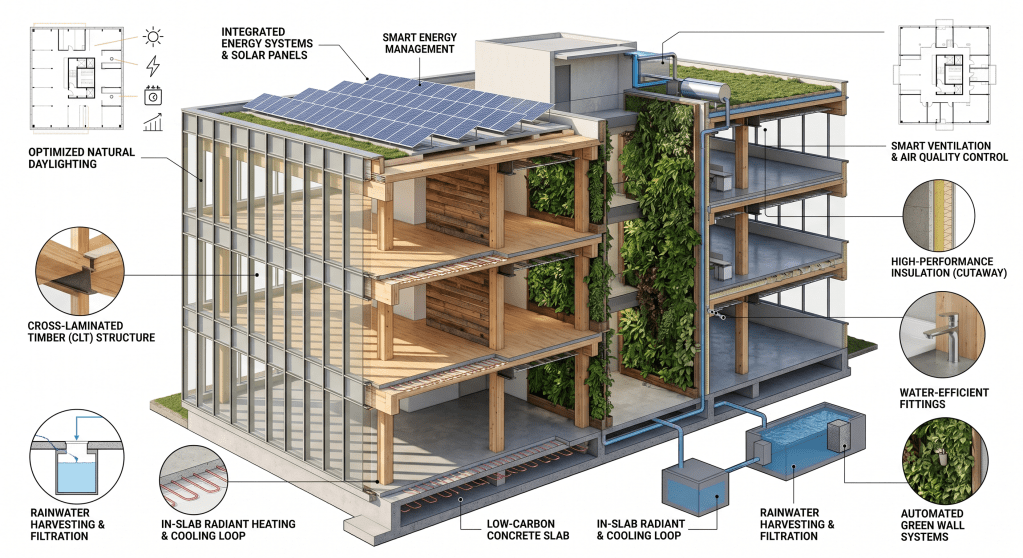
A green building is not defined by one feature alone. Solar panels, indoor plants, or recycled materials may be part of it, but they do not make a building sustainable by themselves. The real goal is to make every major decision better, from site planning and construction materials to ventilation, lighting, waste management, and energy use.
For example, a home with large windows may reduce daytime electricity use through natural light. An office with good insulation may need less air conditioning. A commercial building with rainwater harvesting may reduce dependence on municipal water. These choices work together to create a building that performs better over its full life.
Green Building vs Conventional Construction
Conventional construction often focuses on upfront cost, speed, and basic functionality. Green building looks at the entire life cycle of the project. It asks how much energy the building will consume, how much water it will need, how durable the materials are, and how healthy the indoor environment will be for people.
| Factor | Conventional Construction | Green Building |
| Energy use | Often higher over time | Designed to reduce energy demand |
| Water use | Basic plumbing systems | Water-saving fixtures and reuse systems |
| Materials | Selected mainly on cost and availability | Selected for durability, safety, and lower impact |
| Indoor comfort | May depend heavily on artificial cooling and lighting | Uses ventilation, daylight, and safer materials |
| Long-term cost | Lower upfront cost in some cases | Lower operating cost over time |
Key Elements of Green Building Design
A green building works because multiple design choices support each other. The building has to be planned in a way that reduces resource use, improves durability, and keeps the indoor space comfortable for daily use.
1. Energy-Efficient Building Design
Proper orientation, window placement, wall insulation, roof treatment, and ventilation can reduce the need for artificial lighting and cooling. For example, a building that receives enough natural light during the day can reduce electricity use. Similarly, good insulation helps maintain indoor temperature, which lowers the load on fans, coolers, and air conditioners.
Energy-efficient design may include:
| Design Choice | How It Helps |
| Natural lighting | Reduces daytime electricity use |
| Proper ventilation | Improves airflow and reduces heat buildup |
| High-quality insulation | Keeps indoor temperature stable |
| Energy-efficient appliances | Reduces power consumption |
| Smart lighting controls | Prevents unnecessary electricity use |
| Solar panels | Supports renewable energy generation |
2. Water Conservation Systems
Water conservation is another important part of green building. A sustainable building should reduce water wastage and make better use of available water sources.
This can be done through low-flow taps, dual-flush toilets, rainwater harvesting, drip irrigation, and greywater reuse. In larger residential and commercial projects, wastewater treatment systems can also help reuse water for landscaping, flushing, or cleaning.
3. Eco-Friendly Building Materials
Material selection has a direct impact on the strength, safety, and environmental footprint of a building. Green buildings use materials that are durable, responsibly sourced, and safer for indoor use.
This can include recycled steel, fly ash bricks, bamboo, reclaimed wood, low-VOC paints, certified plywood, and locally available materials. Local sourcing also reduces transportation-related emissions and often helps control costs.
4. Indoor Environmental Quality
Indoor environmental quality includes clean air, natural light, ventilation, temperature comfort, noise control, and low-emission materials. Poor indoor air quality can cause discomfort, fatigue, allergies, and lower productivity, especially in offices and schools.
Green buildings focus on healthier interiors through better airflow, safer finishes, moisture control, and materials that do not release harmful chemicals into the air. This makes the space more comfortable for living, working, learning, and healing.
Benefits of Green Building
Green building is often discussed from an environmental point of view. But its benefits go beyond sustainability. A well-planned green building can reduce monthly operating costs, improve indoor comfort, increase property value, and create a healthier space for people.
1. Lower Operating Costs
One of the biggest benefits of green building is lower running cost. Energy-efficient lighting, better insulation, natural ventilation, solar power, and smart controls can reduce electricity consumption over time.
Water-saving systems also reduce utility bills. Low-flow fixtures, rainwater harvesting, and greywater reuse can bring down water usage, especially in homes, offices, hotels, schools, and commercial buildings.
2. Reduced Environmental Impact
Buildings use large amounts of energy, water, raw materials, and land. They also generate waste during construction and operation. Green building reduces this impact by making better choices at every stage.
This includes using durable materials, reducing construction waste, improving energy performance, and lowering carbon emissions. Renewable energy systems such as solar panels can further reduce dependence on conventional power.
3. Healthier Living and Working Spaces
A building directly affects the people inside it. Poor ventilation, weak natural light, dampness, and chemical-heavy materials can make indoor spaces uncomfortable and unhealthy.
Green buildings focus on cleaner air, better daylight, safer materials, and more comfortable temperatures. Low-VOC paints, adhesives, and finishes help reduce indoor air pollution. Proper ventilation keeps the air fresh and reduces moisture buildup.
4. Higher Property Value
Green buildings can also offer better long-term value. Buyers, tenants, and businesses are becoming more aware of energy savings, healthier interiors, and sustainability standards.
A building with lower running costs and better comfort can be more attractive in the market. Certified green buildings may also gain stronger credibility because their performance has been measured against accepted standards.
For developers and property owners, this can support better tenant interest, stronger resale value, and long-term relevance as sustainability expectations continue to grow.
Green Building Standards and Certifications
Green building standards help turn sustainability claims into measurable performance. They give builders, architects, developers, and buyers a clear way to assess whether a building has been planned and constructed with responsible design practices.
These certifications usually review areas such as energy use, water efficiency, material selection, indoor air quality, waste management, site planning, and occupant comfort.
What Is LEED Certification?
LEED stands for Leadership in Energy and Environmental Design. It is one of the most widely known green building rating systems in the world.
LEED evaluates buildings across different areas, including:
| LEED Assessment Area | What It Measures |
| Energy performance | How efficiently the building uses electricity and fuel |
| Water efficiency | How well the building reduces and manages water use |
| Materials and resources | Whether materials are responsible, durable, and lower-waste |
| Indoor environmental quality | Air quality, lighting, ventilation, and occupant comfort |
| Site planning | How the project manages land use, transport access, and outdoor impact |
A building earns points based on how well it performs in these areas. Based on the total score, it can receive different levels of certification such as Certified, Silver, Gold, or Platinum.
Other Green Building Standards
LEED is popular globally, but it is not the only green building certification. Different countries and project types may use different systems.
| Standard | Common Use |
| BREEAM | Widely used in the UK and other international markets |
| WELL Building Standard | Focuses strongly on health, wellness, and occupant comfort |
| IGBC | Commonly used for green building projects in India |
| GRIHA | India-focused rating system for sustainable habitats |
For Indian projects, IGBC and GRIHA are especially relevant. They consider local climate, building practices, energy needs, and sustainability priorities. This makes them useful for homes, offices, institutions, townships, and commercial spaces in India.
For buyers and tenants, certification builds trust. It shows that the building has been evaluated against defined standards. For businesses, it can support brand reputation, employee comfort, and long-term operating savings.
Certification also helps compare projects more clearly. Instead of relying only on claims like “eco-friendly” or “sustainable,” people can check whether the building meets accepted performance benchmarks.
Is Green Building More Expensive?
Green building is often seen as costly because it may require better planning, certified materials, energy-efficient systems, and specialized design inputs. In some projects, the initial cost can be higher than conventional construction. But that does not mean green building is expensive in the long run.
Green building requires a life-cycle cost view. This means the owner should look at how much the building will cost to operate over 10, 20, or 30 years, not just how much it costs to build today.
| Cost Area | Conventional Building | Green Building |
| Initial construction cost | May be lower in some cases | May be slightly higher due to better materials and systems |
| Electricity bills | Usually higher over time | Lower due to efficient design and appliances |
| Water bills | Higher if there are no conservation systems | Lower with rainwater harvesting and water-saving fixtures |
| Maintenance | Can increase if low-quality materials are used | Often lower when durable materials are selected |
| Indoor comfort | May depend more on artificial cooling and lighting | Better comfort through ventilation, daylight, and safer materials |
| Long-term value | Depends mainly on location and build quality | Can improve due to lower running cost and better performance |
For example, good insulation may add to the initial cost, but it can reduce cooling expenses for years. Low-flow fixtures may cost more than basic fittings, but they reduce water use every month. Solar panels require investment at the start, but they can lower electricity dependence over time.
Green building becomes more practical when it is planned from the beginning. If sustainability is added at the last stage, costs can increase. But when the architect, builder, and material supplier plan together, many green choices can be included without making the project unaffordable.
So, the better question is not, “Is green building more expensive?” The better question is, “What will this building cost to run and maintain over its full life?”
The Role of Materials in Sustainable Construction
Every material used in a building has an impact. Cement, steel, wood, plywood, paint, adhesives, tiles, glass, and insulation all affect how the building performs over time.
A good material choice should answer a few practical questions:
| Question | Why It Matters |
| Will this material last in local weather conditions? | Durable materials reduce repair and replacement needs. |
| Is it safe for indoor use? | Low-emission materials help maintain better indoor air quality. |
| Does it support energy efficiency? | Insulation, glass, and roofing materials can reduce heat gain. |
| Is it responsibly sourced? | Better sourcing reduces pressure on natural resources. |
| Will it create less waste during use or replacement? | Longer-lasting materials reduce construction and renovation waste. |
For example, low-VOC paints and adhesives can reduce indoor air pollution. Good insulation can reduce cooling needs. Durable plywood can make furniture and interiors last longer, which reduces replacement waste.
Future of Green Building and Net-Zero Construction
Green building is moving from “less damage” to “better performance.” Earlier, the focus was mainly on reducing electricity use, saving water, and using safer materials. Today, the goal is becoming more ambitious. Buildings are expected to reduce emissions, generate cleaner energy, and operate with much lower dependence on external resources.
This is where net-zero construction becomes important. A net-zero energy building produces as much energy as it consumes over a defined period, usually through renewable sources such as solar power. A net-zero carbon building goes a step further by reducing or balancing the carbon emissions linked to construction materials, energy use, and operations.
Net-zero construction is not achieved through one feature. It requires better planning across design, materials, energy, water, and operations.
A net-zero-focused building may include:
| Area | Practical Approach |
| Building design | Orientation, insulation, shading, and natural ventilation |
| Energy use | Efficient lighting, appliances, HVAC systems, and smart controls |
| Renewable energy | Solar panels or other clean energy systems |
| Materials | Durable, lower-impact, and responsibly sourced materials |
| Water systems | Rainwater harvesting, reuse systems, and low-flow fixtures |
| Operations | Monitoring energy, water, and maintenance performance |
The future of green building will also depend on smarter technology. Sensors, automation, and energy monitoring tools can help building owners track consumption and reduce waste. This is especially useful for offices, hotels, hospitals, schools, and large residential projects.
Sustainable construction is likely to become more common because the pressure is coming from multiple sides. Buyers want lower running costs. Businesses want better workspaces. Governments are introducing stricter efficiency norms. Developers also know that inefficient buildings may lose market appeal over time.
How Digna Ply Supports Better Material Choices
Digna Ply helps customers choose plywood and hardware based on actual use. A kitchen cabinet, office partition, wardrobe, wall panel, and bathroom vanity do not need the same material. The right recommendation can improve durability, control cost, and reduce future repair issues.
For plywood and hardware enquiries, WhatsApp Digna Ply at 8881306046.
Frequently Asked Questions
What is green building?
Green building is the practice of designing, constructing, and operating buildings in a way that reduces energy use, saves water, lowers waste, and improves indoor comfort. It focuses on long-term performance, not just construction cost.
What are the main features of a green building?
The main features include energy-efficient design, water-saving systems, eco-friendly materials, better ventilation, natural lighting, waste reduction, and healthier indoor spaces. Some green buildings also use solar power and smart monitoring systems.
Is green building more expensive than normal construction?
Green building can cost slightly more at the start, depending on the materials and systems used. But it can reduce electricity bills, water bills, repair costs, and maintenance expenses over time.
What is LEED certification?
LEED certification is a global rating system that measures how sustainable a building is. It looks at energy use, water efficiency, material choices, indoor air quality, site planning, and overall building performance.
Which materials are used in green buildings?
Green buildings may use recycled steel, fly ash bricks, bamboo, certified wood, good-quality plywood, low-VOC paints, low-emission adhesives, and locally sourced materials. The goal is to choose materials that are durable, safe, and resource-efficient.
How does green building reduce energy costs?
Green building reduces energy costs through better insulation, natural light, ventilation, efficient appliances, smart controls, and renewable energy systems like solar panels. These choices reduce dependence on artificial lighting and cooling.
Is plywood suitable for green building projects?
Yes, plywood can be suitable for green building projects when chosen carefully. Durable plywood, responsibly sourced wood products, and low-emission adhesives can support long-lasting interiors and better indoor air quality.


Leave a Reply