Waterproof plywood and HDHMR are widely used in Indian interiors, and both are marketed as strong options for moisture-prone areas. But they are not the same.
Waterproof plywood, especially BWP or IS 710-grade plywood, is designed to handle heavy moisture exposure, while HDHMR is a high-density board made to resist moisture better than regular MDF or particle board.
In this article, we’ll compare waterproof plywood vs HDHMR in a practical way and discuss what each material is, where it works best, where it can fail, and which one makes more sense for different places.
What is Waterproof Plywood?
Waterproof plywood is a type of engineered wood panel made by bonding multiple layers of wood veneers together with strong adhesive. These layers are placed in alternating grain directions, which gives plywood better strength, stability, and resistance to bending. This layered structure is one reason waterproof plywood is widely used in kitchens, bathrooms, wardrobes, partitions, and furniture that needs to handle daily use.
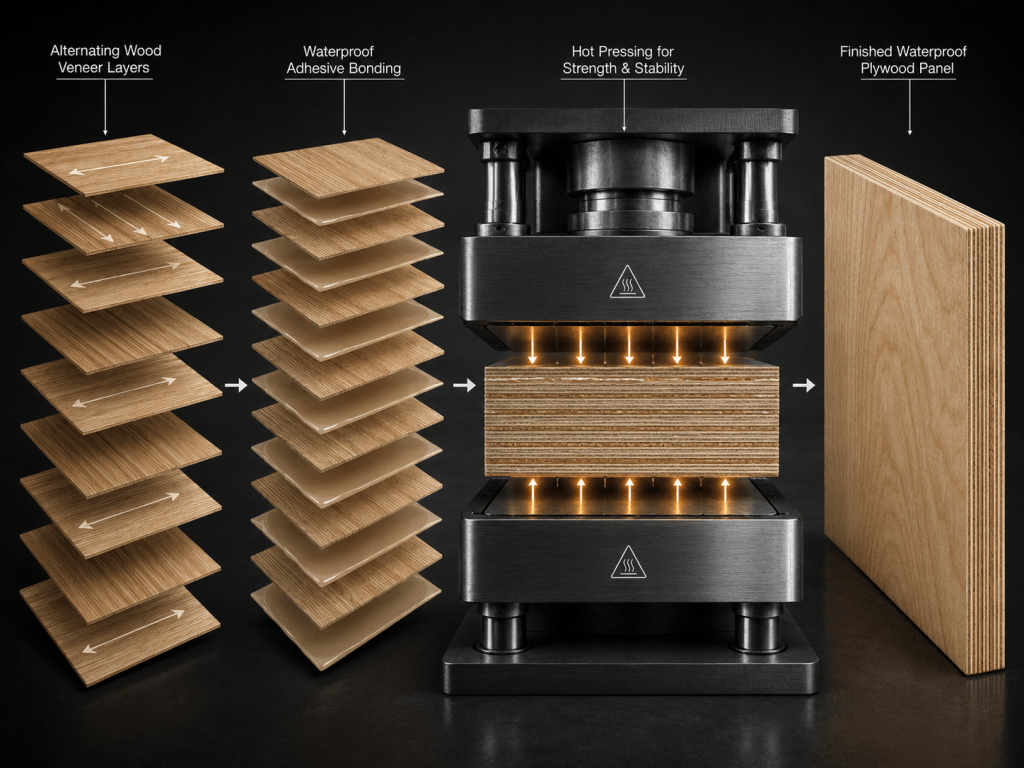
For modular kitchens, the most relevant category is usually BWP plywood, also known as Boiling Water Proof plywood. As the name suggests, it is made to perform better in areas where moisture exposure is high. It is commonly used for kitchen cabinets, under-sink units, bathroom vanities, and other interior areas where regular plywood may not last long.
IS 710 is the Indian standard used for marine-grade or BWP plywood. When plywood is marked as IS 710, it means the product is expected to meet specific quality requirements for water resistance, bonding strength, and durability.
What is HDHMR Board?
HDHMR stands for High-Density High-Moisture Resistant board. It is an engineered wood product made by compressing wood fibres with resin under high pressure and temperature. Compared to regular MDF, HDHMR has higher density and better moisture resistance, which makes it a popular material for modular kitchen shutters, panels, wardrobes, and interior furniture.
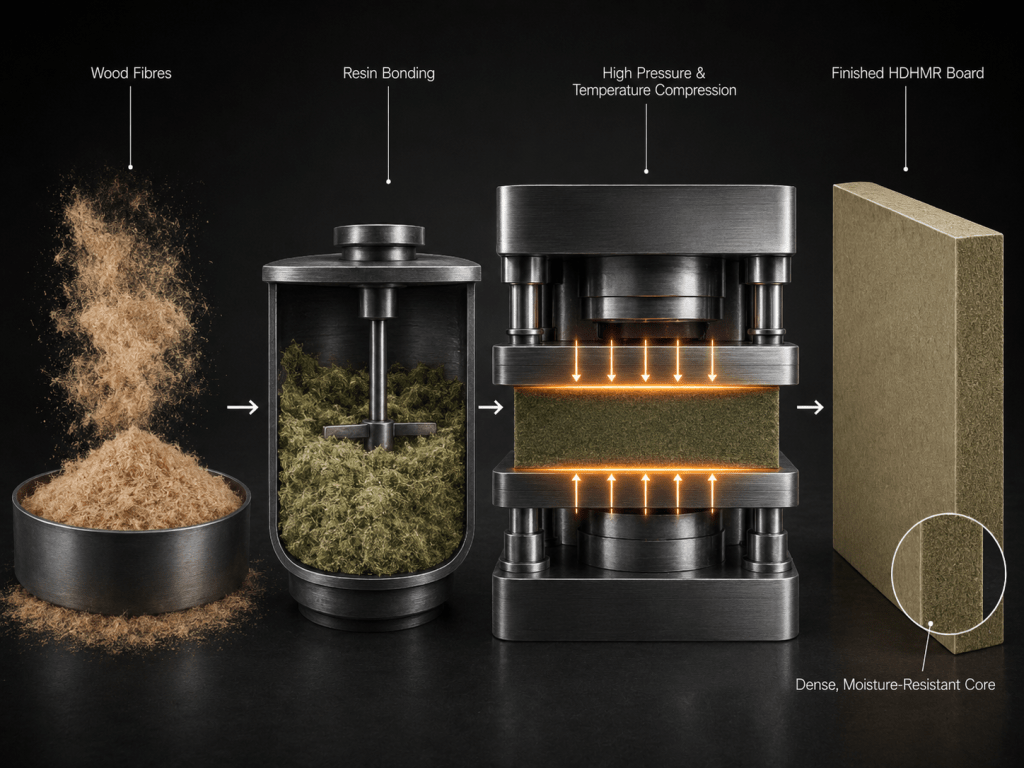
The main reason HDHMR is popular because of its smooth surface. It works well with laminates, acrylic finishes, PU paint, membrane finishes, and machine-cut designs.
Is HDHMR waterproof?
HDHMR is moisture-resistant, but it is not the same as waterproof plywood. HDHMR can handle limited moisture better than regular MDF or particle board. However, if water enters through exposed edges, poor edge banding, screw holes, or damaged surfaces, the board may swell over time. This makes edge sealing and installation quality very important.
For dry or semi-dry kitchen areas, HDHMR can work well. But for under-sink cabinets, water purifier areas, or spaces with regular leakage risk, waterproof plywood is usually the safer choice.
Waterproof Plywood vs HDHMR: Key Differences
Waterproof plywood and HDHMR are both used in modular kitchens, but they behave differently once installed. The difference is not just about price or finish. It is about how the material performs under moisture, weight, screws, hinges, termites, and daily kitchen use.
1. Water resistance
Waterproof plywood, especially BWP or IS 710-grade plywood, is made for areas where moisture exposure is common. It can handle spills, steam, cleaning water, and occasional plumbing leaks better than most wood-based boards.
HDHMR has better moisture resistance than regular MDF or particle board, but it is not fully waterproof. It can perform well in dry and semi-dry kitchen zones, but exposed edges and poor edge banding can become weak points. If water enters the board, swelling can happen over time.
2. Screw-holding strength
Plywood usually has better screw-holding strength because of its cross-layered veneer structure. This matters for hinges, handles, drawer channels, wall-mounted cabinets, and tall storage units.
HDHMR is dense, but it is still made from compressed fibres. It can hold screws reasonably well in many applications, but repeated drilling, heavy shutters, or poor installation can weaken screw grip over time. For areas with frequent opening and closing, plywood is generally more dependable.
3. Termite and borer resistance
Waterproof plywood offers good termite and borer resistance when it is chemically treated during manufacturing. This makes it a strong option for long-term use in Indian homes, especially where pest issues are common.
HDHMR can also be manufactured with termite-resistant properties, depending on the brand and grade. However, buyers should not assume all HDHMR boards offer the same protection. Always check product specifications before purchase.
4. Strength and load-bearing capacity
Plywood is usually better for heavy-duty use. Its layered structure gives it better bending strength and load-bearing capacity. This makes it suitable for base cabinets, wall cabinets, shelves, lofts, and storage units that carry heavy utensils, appliances, or groceries.
HDHMR works better in applications where surface finish and design precision matter more than heavy load-bearing. It is commonly used for shutters, panels, and decorative surfaces. For heavy shelves or structural cabinet bodies, waterproof plywood is usually the safer material.
5. Surface finish and design flexibility
HDHMR has an advantage when it comes to smoothness. Its uniform surface works well with laminate, acrylic, PU paint, membrane finish, and CNC routing. This makes it useful for decorative shutters and modern kitchen designs.
Plywood can also be finished with laminate, veneer, polish, or paint, but its surface may need better preparation before finishing. For the main cabinet body, this is not a major concern. For visible shutters, HDHMR can offer a neater finish when installed correctly.
6. Weight and handling
HDHMR is generally heavier than plywood because of its high-density fibre structure. This can increase pressure on hinges, wall-mounted cabinets, and installation hardware.
Plywood is usually lighter and easier to handle while still offering good strength. For wall cabinets and large kitchen units, this weight difference can matter during installation and long-term use.
HDHMR Board Disadvantages You Should Know
Many buyers hear the term “high-moisture resistant” and assume it means fully waterproof. That is where the confusion begins. HDHMR can work well in the right areas, especially for shutters and decorative panels. But if it is used in high-moisture zones without proper edge sealing, it may not perform as well as expected.
1. It is not fully waterproof
HDHMR is moisture-resistant, not waterproof. It can handle light moisture better than regular MDF or particle board, but it is not designed for long water exposure.
This matters most in under-sink cabinets, dishwasher areas, and spaces near water purifiers. If water seeps into the board through open edges, screw holes, or damaged laminate, the board can swell. Once swelling starts, it is difficult to reverse.
2. It can be heavier than plywood
HDHMR has a dense structure, which also makes it heavier. This can create challenges during installation, especially for wall-mounted cabinets and large shutters.
A heavier shutter can put more pressure on hinges over time. Similarly, heavier wall cabinets need stronger support and better fixing. Poor installation can lead to alignment issues, loose fittings, or sagging.
3. Edge sealing becomes very important
The edges of HDHMR need proper protection. If the laminate, edge banding, or sealing is not done well, moisture can enter from the sides.
This is one of the biggest reasons HDHMR fails in kitchens. The surface may look perfect from the outside, but exposed or poorly finished edges can slowly absorb moisture. For this reason, workmanship matters as much as material quality.
4. It may not hold screws as strongly as plywood
HDHMR has decent screw-holding capacity, but plywood generally performs better for repeated hardware use. Kitchen cabinets need hinges, drawer channels, handles, lift-up fittings, and other accessories that depend on strong screw grip.
Over time, frequent opening and closing can loosen fittings if the base material does not hold screws firmly. This is why plywood is often preferred for cabinet carcasses, heavy shutters, and wall-mounted storage units.
Waterproof Plywood or HDHMR: Which Should You Choose?
The right choice depends on where the material will be used. A modular kitchen has different zones, and each zone does not face the same level of moisture, weight, or daily wear. That is why it is better to choose material based on use case instead of picking one material for the entire kitchen.
For most Indian kitchens, waterproof plywood is better for the main cabinet structure, while HDHMR can be used selectively for shutters and decorative panels. This gives you a balance of strength, durability, and finish.
Waterproof plywood is the better choice when strength and moisture resistance matter more than surface smoothness. It is especially useful for:
| Use Case | Why Waterproof Plywood Works Better |
| Under-sink cabinets | Handles leakage risk and dampness better |
| Base cabinets | Offers better strength for heavy utensils and appliances |
| Wall-mounted cabinets | Holds screws and fittings more reliably |
| Bathroom vanities | Performs better in moisture-prone areas |
| Long-term modular kitchens | Better suited for regular use and load-bearing |
If you want a kitchen that lasts longer with fewer repair issues, BWP or IS 710-grade plywood is usually the safer option.
HDHMR makes sense when the area is not directly exposed to water and the design needs a smooth finish. It can work well for:
| Use Case | Why HDHMR Can Work Well |
| Kitchen shutters | Smooth surface for laminate, acrylic, PU, or membrane finish |
| Decorative panels | Better finish quality and neat machining |
| CNC designs | Easier to cut and route cleanly |
| Dry kitchen zones | Works well where moisture exposure is limited |
| Budget-sensitive visible areas | Can reduce cost when used carefully |
HDHMR should be used only when the edges are sealed properly and the installation quality is good. Without that, moisture can enter through weak points and reduce its life.
The best approach is not always plywood versus HDHMR. In many kitchens, the smarter choice is to use both materials in the right places.
Use waterproof plywood for the cabinet carcass, under-sink area, wall units, and heavy storage sections. Use HDHMR for shutters, decorative panels, or dry-area design elements where a smooth finish is needed.
Get the Right Waterproof Plywood with Digna Ply
At Digna Ply, we help customers choose plywood based on actual kitchen requirements instead of just material names. For example, an under-sink unit needs stronger water resistance than a dry overhead cabinet. A base cabinet that holds heavy utensils needs better load-bearing strength than a decorative shutter. These details matter when you want your kitchen to last longer.
If you are planning a new modular kitchen or replacing old cabinets, choosing the right plywood at the start can save you from swelling, loose hinges, repair costs, and early replacement.
For plywood enquiries, WhatsApp Digna Ply at 8881306046.
Frequently Asked Questions
Is HDHMR better than waterproof plywood?
HDHMR is not better than waterproof plywood for every kitchen use case. It is better for smooth shutters, decorative panels, and CNC designs. Waterproof plywood is better for under-sink cabinets, base units, wall cabinets, and heavy storage areas.
Is HDHMR board 100% waterproof?
No, HDHMR is not 100% waterproof. It is moisture-resistant, which means it can handle light moisture better than regular MDF or particle board. But if water enters through exposed edges, screw holes, or poor edge banding, it can swell over time.
Which is better for under-sink kitchen cabinets?
Waterproof plywood is better for under-sink kitchen cabinets. This area faces higher risk of leakage, dampness, and plumbing moisture. BWP or IS 710-grade plywood is a safer choice for such wet zones.
Does HDHMR have good screw-holding capacity?
HDHMR has decent screw-holding capacity, but plywood usually performs better. Plywood’s layered structure gives stronger grip for hinges, handles, channels, and fittings. This matters in cabinets that are opened and closed daily.
Is BWP plywood worth the higher price?
Yes, BWP plywood is worth the higher price for moisture-prone and heavy-use areas. It may cost more upfront, but it can reduce the risk of swelling, loose fittings, and early replacement.
Which material lasts longer in a modular kitchen?
Waterproof plywood usually lasts longer in modular kitchens when used for the main cabinet structure. HDHMR can also last well if used in dry areas with proper edge sealing and good installation.


Leave a Reply