Office interiors are a business investment. Every desk, workstation, storage unit, partition, and meeting room fixture is expected to perform every day without bending, loosening, swelling, or losing its finish. For offices, plywood selection should be based on application, usage, moisture exposure, safety needs, and finishing requirements.
MR grade plywood may work well for standard office furniture in dry areas, while BWR-grade plywood is better suited for workstations, high-use zones, and spaces exposed to humidity. Fire-retardant plywood may also be required in larger commercial fit-outs where safety standards matter.
This guide breaks down the major commercial plywood grades, ideal office applications, recommended thicknesses, and finishing options so businesses, contractors, and interior designers can make a more practical buying decision.
What Makes Plywood Suitable for Office Interiors?
Office interiors need materials that can handle daily business use without frequent repairs.
A desk in a cabin, a workstation used by multiple employees, a storage cabinet, or an office partition all face different levels of load, movement, and surface wear. This is why plywood should be selected based on performance, not just price or appearance.
Good plywood for office interiors should offer strength, dimensional stability, and a clean surface for laminates or veneers. It should hold screws well, support modular furniture fittings, and resist bending over time. In commercial spaces, these qualities become even more important because furniture failure does not just affect appearance. It can interrupt work, increase maintenance costs, and make the office look poorly maintained.
For most office projects, the right plywood should be judged on these factors:
| Factor | Why It Matters in Office Interiors |
| Strength | Helps desks, cabinets, shelves, and workstations handle daily load |
| Screw-holding capacity | Keeps hinges, channels, handles, and modular fittings stable |
| Moisture resistance | Protects furniture in humid areas or near pantry zones |
| Surface finish | Helps laminates, veneers, and polish look cleaner |
| Dimensional stability | Reduces bending, warping, and uneven furniture alignment |
| Grade suitability | Ensures the plywood matches the application, usage, and budget |
A common mistake businesses make is using the same plywood across the entire office. But a dry storage cabinet, a heavy workstation, a pantry-side unit, and a commercial partition may need different plywood grades.
Different Types of Plywood Used in Offices
A cabin desk, a workstation cluster, a pantry-side cabinet, and a large office partition all face different levels of wear, moisture, weight, and safety requirements. That is why businesses should look at plywood grades before finalizing material for an office interior project.
1. MR Grade Plywood for Office Furniture
MR stands for Moisture Resistant. It is one of the most commonly used plywood grades for regular office furniture because it works well in dry indoor spaces. If your office furniture is not exposed to water, high humidity, or pantry-side conditions, MR-grade plywood can be a practical and budget-friendly choice.
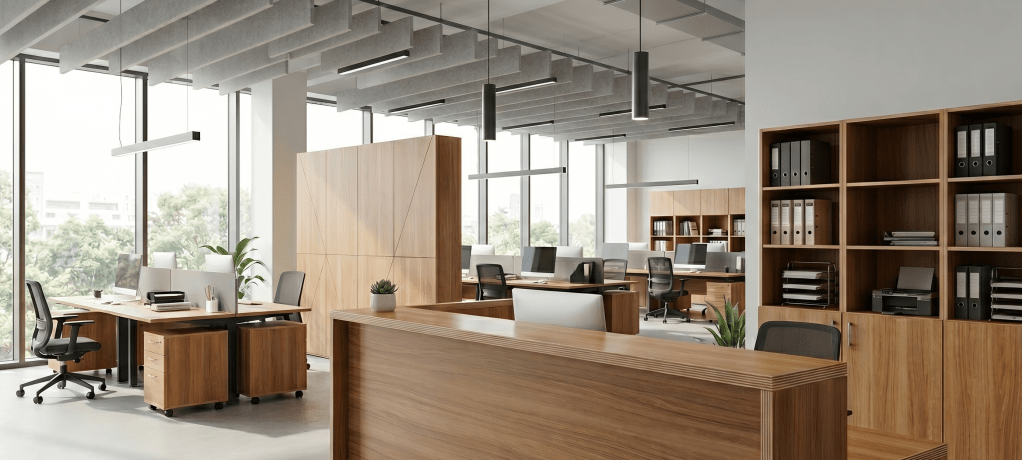
MR-grade plywood is suitable for
- Office desks
- Storage cabinets
- Shelves
- Reception counters
- Filing units
- Basic office partitions in dry areas
For businesses planning standard office furniture, MR-grade plywood offers a good balance between cost and performance. It can handle everyday indoor use when the plywood quality is good and the furniture is designed properly. However, it should not be used in areas where the furniture may come in contact with water or excess moisture.
2. BWR-Grade Plywood for Workstations and High-Use Areas
BWR stands for Boiling Water Resistant. It offers better moisture resistance than MR-grade plywood and is preferred for office areas where furniture is used heavily or may face humidity. In commercial interiors, this makes BWR-grade plywood a better fit for workstations, modular units, pantry-adjacent furniture, and long-term furniture installations.
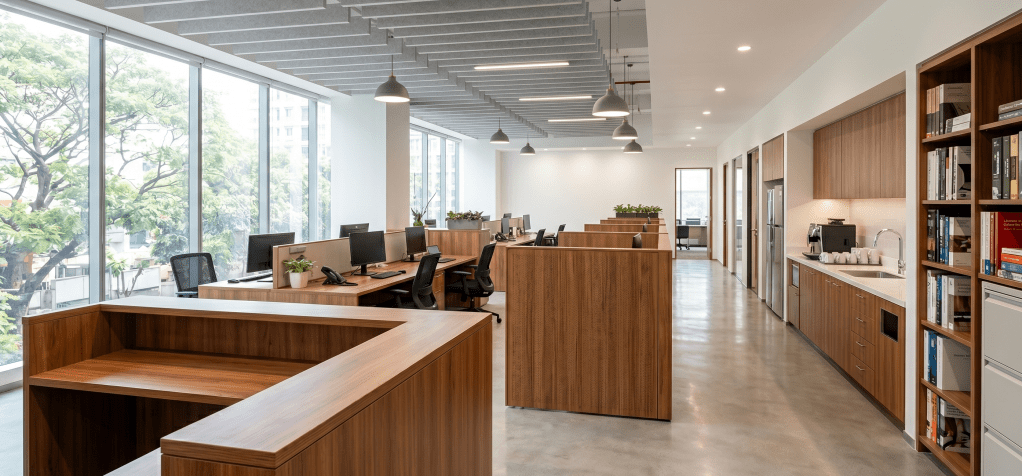
BWR-grade plywood is suitable for:
- Workstations
- Modular office furniture
- Pantry-side cabinets
- High-traffic work areas
- Office cubicles
- Furniture in humid conditions
For offices that want stronger and longer-lasting furniture, BWR-grade plywood can be a better investment. It may cost more than MR-grade plywood, but it reduces the risk of swelling, weakening, and moisture-related damage in demanding conditions.
3. Fire-Retardant Plywood for Commercial Office Safety
Fire-retardant plywood is used in commercial interiors where safety is a major consideration. It is treated to slow down the spread of fire, making it useful for large offices, corporate fit-outs, public-facing commercial spaces, and areas with electrical wiring or wall paneling.
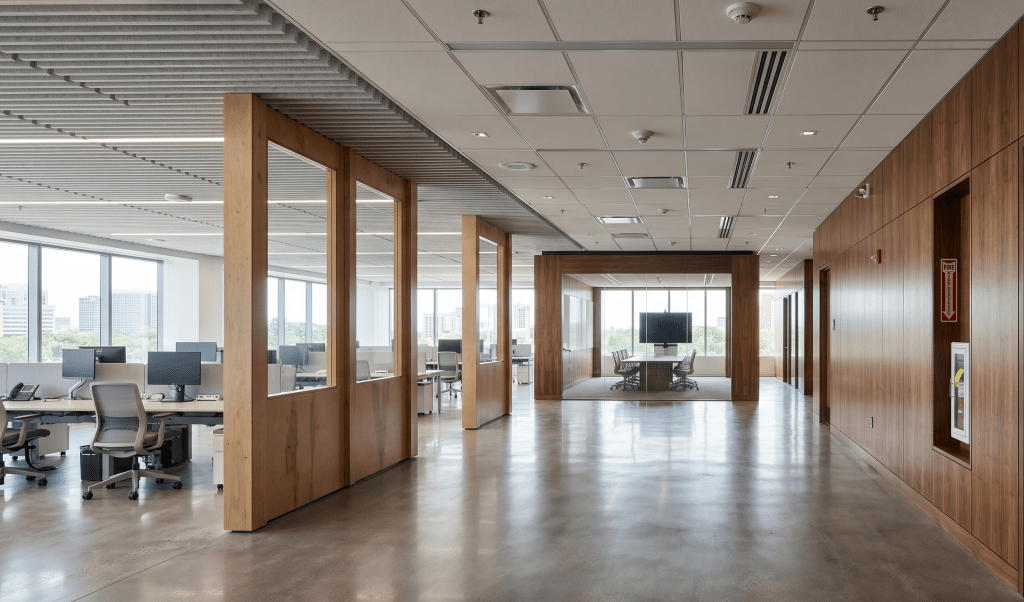
Fire-retardant plywood is commonly used for:
- Office partitions
- Wall paneling
- Electrical rooms
- Large commercial fit-outs
- Conference rooms
- Shared office spaces
For small offices, fire-retardant plywood may not be used everywhere. But for larger office projects, it is worth considering in safety-sensitive areas. It adds another layer of protection while still giving interior designers the flexibility to use laminates, veneers, or other finishes.
Best Plywood for Different Office Applications
Once you know the main plywood grades, the next step is to match them with the right office application. This is where many businesses make mistakes. They either choose a low-cost board for every area or overpay for premium plywood where it is not required.
A better approach is to divide the office into usage zones. Desks, partitions, cubicles, storage units, and pantry-side furniture all have different material needs.
1. Plywood for Office Desks
Office desks need plywood that can hold weight, stay level, and support daily use without bending. For most desks, 18mm plywood is commonly preferred because it gives good strength and stability.
If the desk has a long span or heavy equipment, the design may need additional support or thicker plywood. For premium modular desks, calibrated plywood works better because it offers uniform thickness and helps achieve a cleaner laminate finish.
For regular office desks, MR-grade plywood can work well in dry areas. For high-use workstations or shared desks, BWR-grade plywood is a better choice.
2. Plywood for Office Partitions
Office partitions need stability, clean finishing, and good screw-holding strength. They may not carry heavy loads like desks, but they still need to stay straight and firm over time.
For basic dry partitions, MR-grade plywood can be used. For larger commercial offices, conference rooms, and high-traffic areas, fire-retardant plywood is often a better option. It improves safety and is more suitable for commercial fit-outs where partitions cover large wall areas.
A thickness of 12mm is commonly used for wall paneling and light partitions. The final choice depends on partition height, frame support, and finish requirements.
3. Plywood for Office Cubicles
Office cubicles go through more wear than many people assume. Employees lean on them, move chairs around them, attach fittings, and use them daily for years. That means the plywood should offer strength, stability, and a smooth surface for laminates.
MR-grade plywood can work for standard cubicles in dry office spaces. BWR-grade plywood is better for long-term installations, high-traffic zones, or offices that want better durability. If safety is a priority, fire-retardant plywood can be considered for partition-heavy layouts.
The right choice depends on the office size, budget, and expected usage.
4. Plywood for Storage Units and Cabinets
Storage units need plywood that can handle load without sagging. Filing cabinets, document shelves, pantry cabinets, and equipment storage units should be planned based on what they will hold.
For light storage, MR grade plywood is usually enough. For heavier shelves or units near pantry areas, BWR grade plywood is a safer choice. Shelf length also matters. Longer shelves may bend over time if the plywood is too thin or poorly supported.
For most office cabinets and shelves, 18mm plywood is a practical option. For back panels and drawer bottoms, thinner plywood such as 6mm to 9mm can be used depending on the design.
MR vs BWR Plywood for Office Interiors
For most office projects, the decision often comes down to MR grade plywood and BWR grade plywood. Both can be used in commercial interiors, but they are not meant for the same conditions. The right choice depends on how the furniture will be used, where it will be placed, and how long the business expects it to last.
MR grade plywood is suitable for dry office areas where furniture is not exposed to water or high humidity. BWR grade plywood offers better moisture resistance and is better suited for workstations, pantry-side furniture, high-use zones, and long-term modular office setups.
| Factor | MR Grade Plywood | BWR Grade Plywood |
| Nature | Moisture Resistant | Boiling Water Resistant |
| Best Use | Dry office furniture | Workstations and high-use areas |
| Moisture Resistance | Basic protection | Better protection |
| Cost | More affordable | Higher than MR grade |
| Durability | Good for regular office use | Better for long-term commercial use |
| Suitable For | Desks, cabinets, shelves, reception counters | Workstations, cubicles, pantry-side units, modular furniture |
| Best For Businesses That Want | Cost-effective indoor furniture | Longer-lasting furniture with better moisture resistance |
MR grade plywood makes sense when the office has standard furniture requirements and controlled indoor conditions. For example, cabin desks, filing units, shelves, and storage cabinets in dry spaces can work well with good-quality MR plywood.
BWR grade plywood is a better choice when furniture faces heavier usage or moisture risk. This includes shared workstations, pantry-adjacent cabinets, cubicles, and modular furniture that the business does not want to replace or repair frequently. The upfront cost may be higher, but it can reduce maintenance issues over time.
For many offices, the best approach is not to choose one grade for everything. Use MR grade plywood where conditions are dry and usage is moderate. Use BWR grade plywood where durability and moisture resistance matter more. This keeps the project practical without compromising furniture performance.
Recommended Plywood Thickness for Office Furniture
Plywood thickness plays a major role in how office furniture performs over time. Even the right grade can fail if the thickness is not suitable for the application. A desk with weak plywood may bend, a long shelf may sag, and a partition may feel unstable if the material is too thin.
For office interiors, thickness should be selected based on load, span, furniture design, and daily usage. A back panel does not need the same plywood thickness as a workstation top. Similarly, a light wall panel does not need the same board as a heavy-duty meeting table.
| Office Application | Recommended Thickness |
| Drawer bottoms and back panels | 6mm to 9mm |
| Wall paneling and light partitions | 12mm |
| Office desks, cabinets, and shelves | 18mm |
| Heavy-duty tables and structural furniture | 25mm |
For most office desks, cabinets, shelves, and modular furniture, 18mm plywood is a practical choice. It offers enough strength for daily use and works well with laminates, hardware fittings, and edge banding. This is why it is commonly used in workstations, storage units, and standard office furniture.
For wall paneling and partitions, 12mm plywood can work well when there is proper frame support. For drawer bottoms, cabinet backs, and non-load-bearing parts, thinner plywood such as 6mm to 9mm is usually enough. For heavy-duty conference tables, long counters, or furniture expected to carry more weight, 25mm plywood may be a better option.
Businesses should also consider the design before finalizing thickness. A long shelf, wide desk, or unsupported tabletop may need stronger plywood or extra support. Choosing the right thickness at the start helps reduce bending, repair work, and early replacement.
Laminated and Calibrated Plywood for Better Office Finish
Office furniture is judged not only by how strong it is, but also by how clean and consistent it looks after installation. In commercial interiors, uneven surfaces, visible gaps, poor laminate bonding, and misaligned edges can make even a new office look poorly finished. This is where laminated and calibrated plywood become useful.
Laminated plywood is plywood finished with a decorative laminate layer. It is widely used in office interiors because it gives desks, cabinets, cubicles, counters, and partitions a clean surface that is easy to maintain. Laminates also come in multiple colors, textures, and patterns, which helps businesses match furniture with the overall office design.
For office interiors, laminated plywood works well for:
- Workstation tops
- Office desks
- Reception counters
- Storage cabinets
- Meeting tables
- Wall panels
- Cubicle surfaces
Calibrated plywood is different. It is manufactured to maintain uniform thickness across the board. This matters in modular office furniture because even small thickness variations can affect alignment, edge finishing, laminate pressing, and hardware fitting.
For example, if multiple boards are being used to create workstation clusters or cabinet units, uneven thickness can create visible differences after installation. Calibrated plywood helps avoid these issues and gives fabricators a more reliable base for precise work.
For businesses investing in premium office interiors, calibrated plywood can make a clear difference in finish quality. It helps achieve sharper edges, smoother laminate application, better furniture alignment, and a more consistent final look. While it may cost more than regular plywood, it is often worth considering for visible office furniture such as desks, meeting tables, reception counters, and modular workstations.
Summing up, laminated plywood improves the final appearance, while calibrated plywood improves the accuracy of the furniture build. When used together, they help create office interiors that look cleaner, last longer, and need fewer finishing corrections after installation.
How to Choose the Right Plywood for Your Office Project
Choosing plywood for an office project is easier when you follow a clear process. Instead of using the same board everywhere, match the plywood grade, thickness, and finish to the furniture type and usage.
Step 1: List Every Office Application
Start by listing where plywood will be used in the office.
This may include:
- Office desks
- Workstations
- Cubicles
- Storage cabinets
- Filing units
- Wall paneling
- Office partitions
- Reception counters
- Pantry-side cabinets
- Meeting tables
This helps you avoid one common mistake: buying one plywood grade for the entire project without checking where each board will be used.
Step 2: Divide the Office into Usage Zones
Next, divide the office into different usage zones based on daily wear, moisture exposure, and safety needs.
| Office Zone | Examples |
| Regular dry areas | Cabin desks, shelves, storage cabinets |
| High-use areas | Workstations, cubicles, shared desks |
| Moisture-risk areas | Pantry-side cabinets, humid corners |
| Safety-sensitive areas | Partitions, wall panels, electrical rooms |
| Premium visible areas | Reception counters, meeting tables, executive desks |
This step helps you choose plywood based on actual business use, not just price.
Step 3: Match the Right Plywood Grade to Each Area
Once the zones are clear, select the plywood grade for each application.
- Use MR grade plywood for regular dry-area furniture such as desks, cabinets, shelves, and filing units.
- Use BWR grade plywood for workstations, cubicles, pantry-side furniture, and high-use office areas where better moisture resistance and durability are needed.
- Use fire-retardant plywood for large partitions, wall panels, electrical rooms, and commercial fit-outs where fire safety is a priority.
- Use calibrated plywood for modular furniture where uniform thickness and clean alignment matter.
- Use laminated plywood for visible furniture where the final appearance and surface durability matter.
Step 4: Choose the Right Thickness
After selecting the plywood grade, decide the thickness based on load and furniture design.
| Office Application | Recommended Thickness |
| Drawer bottoms and back panels | 6mm to 9mm |
| Wall paneling and light partitions | 12mm |
| Office desks, cabinets, and shelves | 18mm |
| Heavy-duty tables and structural furniture | 25mm |
For most office desks, shelves, and cabinets, 18mm plywood is a practical choice. For partitions and wall panels, 12mm plywood can work well when supported by a proper frame.
Step 5: Check Hardware and Finish Requirements
Office furniture often needs hinges, drawer channels, handles, locks, edge bands, and laminate finishes. The plywood should hold screws properly and support clean finishing.
This is especially important for modular workstations, cabinets, and desks. If the plywood has uneven thickness or poor surface quality, the final furniture may show gaps, rough edges, or alignment issues.
Step 6: Compare Cost with Long-Term Use
The cheapest plywood may reduce the first bill, but it can increase repair and replacement costs later. In office interiors, furniture is used daily and expected to last for years.
A better approach is to spend where performance matters most. Use MR grade plywood for dry, low-risk furniture. Use BWR, fire-retardant, or calibrated plywood where the usage, safety needs, or finish quality justify it.
Get the Right Office Plywood from Digna Ply
At Digna Ply, we help businesses, contractors, furniture makers, and interior designers choose plywood based on actual office use. Instead of selecting boards only by price, you can choose plywood based on grade, thickness, finish, durability, and application.
For office plywood inquiries, WhatsApp Digna Ply at 8881306046.
Frequently Asked Questions
Which plywood is best for office furniture?
MR-grade plywood is suitable for standard office furniture used in dry indoor areas. It works well for desks, shelves, filing units, and storage cabinets. For workstations, cubicles, pantry-side furniture, or high-use office areas, BWR-grade plywood is a better choice because it offers stronger moisture resistance and better long-term durability.
Is BWR plywood required for office desks?
BWR plywood is not required for every office desk. If the desk is placed in a dry cabin or regular office area, good-quality MR-grade plywood can work well. However, if the desk is part of a shared workstation, used heavily every day, or placed near humid areas, BWR plywood is a safer option.
What thickness is best for office desks?
For most office desks, 18mm plywood is commonly used. It provides good strength, supports daily work use, and works well with laminates, edge banding, and hardware fittings. For larger tables, meeting room furniture, or heavy-duty counters, 25mm plywood may be considered.
Can MR grade plywood be used for office partitions?
Yes, MR-grade plywood can be used for office partitions in dry indoor spaces. It works well for basic internal partitions when supported by a proper frame. For larger commercial offices, wall panels, or safety-sensitive areas, fire-retardant plywood may be a better option.
Is fire-retardant plywood necessary for offices?
Fire-retardant plywood is not always used in every part of an office. However, it is recommended for larger commercial spaces, office partitions, wall paneling, electrical rooms, and areas where safety requirements are higher. It adds an extra layer of protection by slowing the spread of fire.
What is calibrated plywood used for in office interiors?
Calibrated plywood is used when uniform thickness and clean finishing are important. It is useful for modular office furniture, workstations, desks, cabinets, and reception counters. Since the thickness is more consistent, it helps improve alignment, laminate finish, and hardware fitting.
Is laminated plywood good for office interiors?
Yes, laminated plywood is widely used in office interiors because it offers a clean, finished surface. It is suitable for desks, workstations, cabinets, partitions, reception counters, and meeting tables. Laminates also make office furniture easier to clean and maintain.
How do I choose plywood for my office project?
Start by listing where plywood will be used. Then divide the office into dry areas, high-use areas, moisture-risk areas, visible furniture areas, and safety-sensitive zones. Use MR plywood for regular dry furniture, BWR plywood for workstations and humid areas, fire-retardant plywood for safety-focused spaces, and calibrated or laminated plywood where finish quality matters.


Leave a Reply